
Cement Products Built for Stronger, More Beautiful Spaces
A well-made cement product does more than fill a construction requirement. It gives a home, boundary, garden or commercial property a lasting visual identity. Balodiya Cemented Products, with over 35 years of experience, creates practical and decorative cement solutions for customers across Punjab, Rajasthan, Haryana and Himachal Pradesh who want dependable construction quality without giving up design.
Design detail with the confidence of durable cement
Our range brings together traditional craftsmanship and repeatable production methods. Fiber-wire reinforcement, careful mould preparation, controlled curing and finishing checks help each piece perform in real outdoor conditions. From one custom element for a residence to a coordinated bulk order for a contractor, our team helps turn an idea into a finished product that is easier to install and maintain. Every product is built keeping North Indian climate and construction methods in mind.
When you invest in quality cement products, you are investing in something that will last decades. Cheap imitations crack within months, lose surface texture and require costly repairs. Our products are designed and manufactured to resist weathering, moisture, UV exposure and the physical stress of daily use. The combination of right materials, tested mixes and skilled finishing ensures every product we supply earns its place on a building.
- Residential elevations and entrance features
- Boundary walls, gates and ventilation panels
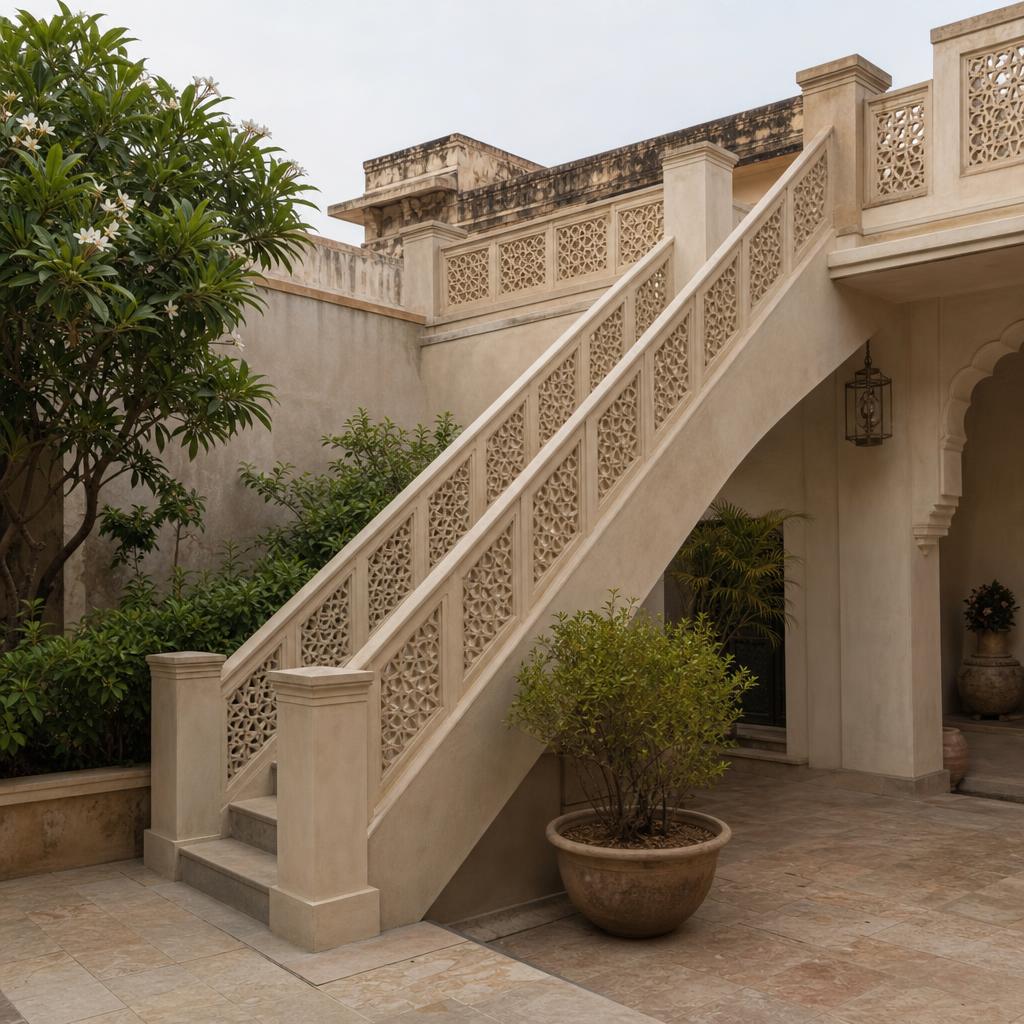
- Stairs, railings, pillars and architectural accents
- Garden furniture, planters, tiles and outdoor décor
- Commercial, farmhouse and temple applications
- Custom sizes and patterns for any project
What makes our cement products different from the market
In the North Indian construction market, cement products are available from many sources — local workshops, roadside suppliers, and large factories. Most buyers choose based on price alone and discover the problem only after installation: hairline cracks appear within months, surfaces powder under humidity, edges chip during transport, or dimensions do not match what the mason prepared. At Balodiya Cemented Products, we have spent over 35 years developing production methods that solve these problems before the product ever leaves the workshop.
The foundation of a good cement product is the mix. We use carefully proportioned cement, aggregate and water ratios suited to the product type and its expected use. A jali screen needs a different density and reinforcement from a heavy garden bench. A decorative pillar cap needs smooth surface quality and accurate edges. A boundary wall coping needs to resist rain, moss and freeze-thaw cycles. Understanding what the product will face — structurally, visually and climatically — is what allows us to make the right mix decisions for each category.
Fiber-wire reinforcement is added during the casting process for products that will carry load or span openings. This internal reinforcement works with the cement matrix to reduce cracking under stress and improve handling strength. Customers often see the surface of a cement product and assume it is simply poured concrete. The reinforcement inside, the mould quality and the curing discipline are invisible but essential to the product's long-term behaviour.
Moulds are prepared carefully before each pour. A worn or poorly aligned mould produces a product that looks acceptable at the workshop but develops problems on site — panels that do not sit flush, frames that rock on uneven bases, surfaces with pitting or discolouration. We maintain and replace moulds to keep the production standard consistent, particularly for high-visibility products like jali screens, pillar caps and railing panels that are seen up close and judged by their surface quality.
Curing is the most patient part of our process. Adequate curing allows the cement to develop its design strength rather than drying too quickly under sun or wind. Cement that is properly cured has better resistance to surface wear, is less likely to develop fine cracks and accepts paint or surface treatment more uniformly. We do not rush this stage even when there is delivery pressure, because a weak product causes more problems than a delayed delivery.
After curing, each product goes through a finishing and inspection check. Corners, edges, surfaces, frame alignments and fixing points are reviewed. Products that do not pass are reworked or replaced rather than dispatched with defects. This check also includes dimensional verification — if a jali was ordered to a specific size, it should leave the workshop at that size, not with tolerances that force the mason to adjust on site.
For customers in Punjab, Rajasthan, Haryana and Himachal Pradesh, the local construction context matters. Summers are intense, winters can be cold in hill areas and the monsoon season brings sustained moisture. Products that look good in a factory photograph may not perform adequately in these conditions. Our 35 years of experience in this region means we build products for real Indian conditions, not laboratory ideals.
The range of cement products we make covers nearly every need a residential or commercial construction project might have. Jali screens for boundary walls and balconies, pillar caps and body panels for entrance gates, stair railing panels for indoor and outdoor staircases, garden benches and planters for outdoor spaces, decorative tiles for courtyard floors and wall features, cement bricks for landscape masonry — and custom elements for any application a customer cannot find ready-made. This breadth of product range means a customer can source all their architectural cement needs from a single dependable supplier rather than managing multiple vendors.
Types of cement products we supply
Understanding the range helps customers plan their projects completely. Our product categories cover the entire built environment of a home or commercial property:
Jali and ventilation screens: Available in dozens of patterns, from traditional geometric to floral to modern abstract. Used on boundary walls, balconies, staircase openings, garden partitions and facade details. Custom sizes and pattern development are available for specific projects.
Pillars and pillar components: Base plinths, shaft panels, capitals and full pillar assemblies for entrance gates, porches, boundary walls and interior architectural features. Ready-made standard sizes and fully custom dimensions are both possible.
Stair railings and balusters: Decorative cement railing panels for main entrance staircases, terrace stairs, interior staircases and courtyard steps. Designed to coordinate with the jali pattern or pillar design used elsewhere on the property.
Garden and outdoor furniture: Cement benches, tables, planters and seating combinations for gardens, courtyards, resorts, parks and commercial outdoor areas. Built for permanence and low maintenance.
Boundary wall components: Coping stones, jali inserts, pillar caps, decorative friezes and full boundary wall panel systems. Designed to work together as a coordinated system rather than mismatched pieces.
Decorative tiles: Cement floor tiles, courtyard tiles, pathway tiles and wall feature tiles in various patterns and sizes. Suitable for covered areas and open-air applications.
Cement bricks: Solid and perforated cement bricks for landscape walls, raised beds, boundary edges and masonry fill applications.
Six things that make a cement product project successful
Measure before ordering
Accurate measurements are the foundation of a smooth project. Provide wall opening sizes, floor-to-ceiling heights, staircase widths and gate post positions before finalising any order. A product made to the right dimension installs cleanly and requires minimal adjustment on site, saving the mason time and reducing the risk of damage during fitting.
Choose pattern for the scale
A fine geometric jali pattern reads beautifully on a small balcony screen but may look too delicate on a long boundary wall. Conversely, a large, bold pattern on a small panel can feel heavy. We help customers select patterns that are proportionate to the product size and the viewing distance — street level versus close contact at a doorstep.
Plan the full visual language
The most successful property elevations use a consistent vocabulary of one or two patterns repeated across the jali, railing, pillar and tile. Repeating a proportion or texture creates cohesion. Mixing unrelated patterns from different suppliers creates a confused elevation that does not photograph well and does not feel considered when seen from the road.
Allow proper curing time
New cement products should not be painted or sealed immediately after installation. Allow a full curing and drying period before applying any surface treatment. Painting over uncured cement traps moisture, causes paint failure and can hide developing cracks. Once adequately cured, a light surface preparation and a quality exterior paint will give a finish that lasts for years.
Prepare the installation area
The mason should prepare a clean, level base or opening before the product arrives. Products that are forced into an uneven bed or opening crack or chip under the installation stress. Provide the mason with product dimensions in advance so the mortar bed, frame alignment and fixing points are ready when the cement product arrives on site.
Maintain regularly, simply
Cement products require minimal but consistent care. Brush off dust and debris before it builds up. Clear standing water from flat surfaces. Avoid pressure washing at close range, which can damage surface texture. Touch up paint chips before moisture penetrates. Small acts of maintenance extend the life and appearance of a cement product significantly beyond neglected examples.
From first idea to installed product
Most customers come to us with a reference photograph, a rough measurement, and a general sense of what they want. That is a perfectly good starting point. Our job is to help translate that starting point into a specific, buildable specification that the workshop can produce and the mason can install without confusion.
The first conversation typically covers: what is the product, where will it be placed, what size does the space need, what pattern or style is preferred, what finish is wanted, how many pieces are required, when is the project deadline, and where is the delivery location. These questions are not bureaucratic. Each answer shapes the product design, the production timeline, the delivery logistics and the final cost.
After this conversation, we can suggest specific product options — ready-made designs that can be adjusted to size, or custom designs developed from the customer's reference. For custom work, we may prepare a mould profile or sketch for review before production begins. This extra step reduces the risk of producing a product that the customer does not recognise as what they imagined.
During production, we maintain communication about progress, particularly for large or complex orders. If a challenge arises — an unusual dimension that requires a different mould approach, or a pattern that needs scaling — we discuss it with the customer rather than making a unilateral decision. Transparency during production means fewer surprises at delivery.
Delivery is planned in coordination with the site schedule. Cement products should arrive when the mason is ready to install, not weeks before when they will sit exposed to weather and site traffic, or after the masonry is complete and the opening cannot be adjusted. We discuss delivery timing as part of the order process, not as an afterthought.
After installation, we are available to discuss any questions about finishing, painting or care. Our experience with how products perform over years in North Indian conditions means we can give practical, relevant advice rather than generic maintenance instructions that do not consider local climate and use patterns.
| Product category | Common applications | Custom sizing | Delivery regions |
|---|---|---|---|
| Cement jali | Boundary walls, balconies, staircase openings | Yes | Punjab, Rajasthan, Haryana, HP |
| Cement pillars | Gate posts, entrance porches, boundary walls | Yes | Punjab, Rajasthan, Haryana, HP |
| Stair railing | Main entrance stairs, terrace, indoor stairs | Yes | Punjab, Rajasthan, Haryana, HP |
| Garden furniture | Gardens, courtyards, parks, resorts | Yes | Punjab, Rajasthan, Haryana, HP |
| Cement tiles | Courtyards, pathways, wall features | Standard + custom | Punjab, Rajasthan, Haryana, HP |
| Cement bricks | Landscape masonry, raised beds, boundary edges | Standard sizes | Punjab, Rajasthan, Haryana, HP |
| Cement planters | Gardens, entrances, commercial landscaping | Yes | Punjab, Rajasthan, Haryana, HP |
Before you place a cement product order
What type of cement products does Balodiya Cemented Products make?
We make and supply a full range of decorative and functional precast cement products including jali screens, pillar systems, stair railing panels, boundary wall components, garden benches, planters, tiles, bricks and fully custom pieces for residential, commercial, farmhouse and temple projects.
Can I order cement products in custom sizes?
Yes. Custom sizing is one of our most common requests. Share the required opening dimensions, wall thickness, number of pieces and a reference photograph or sketch. We will discuss a suitable mould, reinforcement approach and finish for your specific application.
How long does production take for custom cement products?
Production time depends on complexity, quantity and current workshop load. Simple custom-sized versions of existing designs typically take less time than fully new moulds. We discuss realistic timelines when you place the order and keep you informed during production.
Do you deliver across Punjab, Rajasthan, Haryana and Himachal Pradesh?
Yes. We regularly supply cement products across all four states. Delivery logistics depend on product size, quantity, packaging requirements and site access. We discuss delivery arrangements when confirming your order.
What reinforcement is used in your cement products?
We use fiber-wire reinforcement integrated into the cement mix during casting. For load-bearing or spanning products, additional structural reinforcement may be added. The reinforcement type is chosen based on the product's function and the stresses it will encounter in use.
How do I get a price for my project?
Share product type, dimensions, quantity, preferred pattern and delivery location. Our team will provide a realistic estimate and, if needed, discuss options that suit your budget without compromising durability.
Can cement products be painted?
Yes. Allow adequate curing and drying after installation before painting. Use a quality exterior paint and a light surface primer. Avoid painting fresh cement as trapped moisture causes paint failure and can accelerate surface deterioration.
What makes your products better than local market alternatives?
Our products are backed by 35+ years of production experience, consistent mix quality, proper curing, dimensional accuracy and pre-dispatch inspection. Many local market alternatives use poor mixes, skip curing and do not check dimensions, leading to products that fail within the first rainy season.
Have a measurement, sketch or reference ready?
Share the product type, dimensions, quantity, location and preferred look. Our team at Balodiya Cemented Products will help you choose a practical, durable direction for your home, boundary, staircase or outdoor space. We have been doing this for over 35 years and we understand what works in real North Indian construction projects.