
Precast Cement Products With Repeatable Quality and Lasting Strength
Precast cement products offer an important advantage over cast-in-place construction: they are made in controlled workshop conditions, cured properly before delivery and arrive on site ready to install with consistent dimensions and predictable quality. Balodiya Cemented Products has been manufacturing precast cement products for residential, commercial and outdoor projects across North India for over 35 years — supplying jali screens, pillars, railings, benches, planters, tiles and custom architectural elements that builders and homeowners can rely on.
Why precast cement outperforms site-cast alternatives
When cement is cast in a factory or workshop rather than on site, the production conditions are far more controlled. Temperature, humidity, mix water ratio, vibration during casting, mould alignment and curing duration can all be managed systematically. On a construction site, these factors vary with the weather, the experience of the crew and the pressure of the schedule. The result is that precast cement products consistently deliver better dimensional accuracy, better surface quality and better structural reliability than their site-cast equivalents.
For decorative elements — jali screens, pillar sections, railing panels, step nosing details and garden furniture — the quality advantage of precast production is especially significant. These elements are judged by their visual precision: the sharpness of the pattern edges, the uniformity of the surface texture, the accuracy of the dimensions. None of these qualities can be consistently achieved with site-cast production in typical North Indian construction site conditions.
- Jali screens for boundary walls and balconies
- Pillar systems for gates and porches
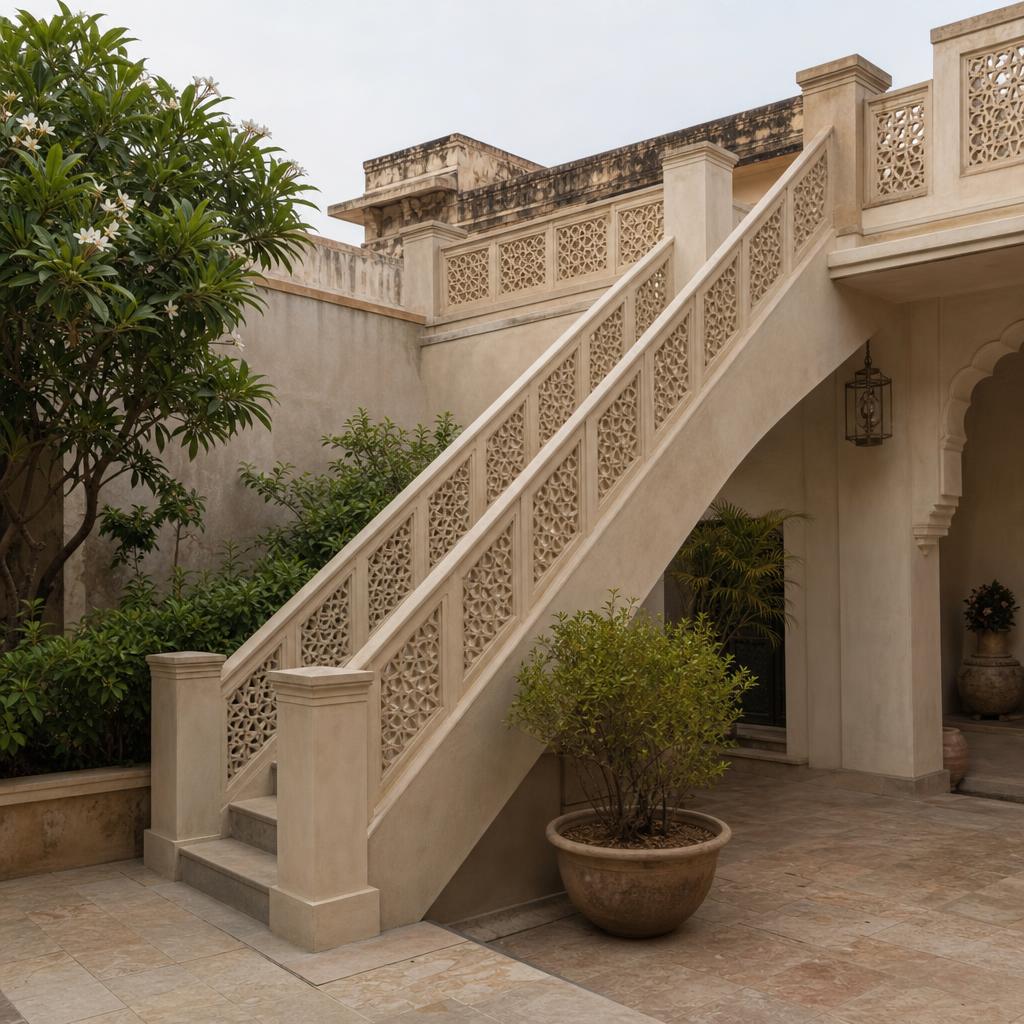
- Stair railing panels and posts
- Garden benches, planters and furniture
- Decorative tiles and courtyard surfaces
- Custom architectural precast elements
What precast production means for your project
Precast cement production means every product is made in a workshop under consistent, controlled conditions before being delivered to the construction site. This fundamental difference in production method has important practical implications for the buyer, the installer and the long-term performance of the finished product.
Mix quality is the first advantage. In a workshop, the cement mix is batched from consistent raw materials in controlled proportions. The same mix formula is used for the same product category every time, so the product strength, density and surface character are predictable and repeatable. On a construction site, mix quality varies with the availability of materials, the precision of the crew and the conditions on the day. Workshop batching eliminates these variables.
Mould quality is the second advantage. Precast workshops invest in well-made moulds that produce consistent surface texture, sharp edge definition and accurate dimensions. A good mould lasts for hundreds of pours when properly maintained. Site-cast formwork is typically made from whatever materials are available, is rarely as precise as a dedicated mould and is not designed for reuse across many identical elements. The surface quality difference between a good mould and improvised formwork is immediately visible in the finished product.
Curing is the third and perhaps most important advantage. Proper curing — maintaining the cement at the right moisture level for an adequate period — allows the product to develop its design strength. Workshop curing can be managed systematically: products are kept in shaded, humid conditions for the right duration before they are moved or loaded. Site conditions rarely allow this discipline. Products that are not properly cured reach only a fraction of their design strength and are more vulnerable to surface deterioration and cracking under the first season of weather and use.
Dimensional accuracy is the fourth advantage that directly benefits the installer. A precast product made from a well-maintained mould to verified dimensions arrives on site ready to install with minimal adjustment. The mason can prepare the fixing bed, opening or base to the specified dimension in advance, knowing the product will match. Products with dimensional inconsistencies require adjustment on site — cutting, packing, shimming — that takes time and risks damaging the product or the masonry it is being fixed into.
Transport and handling are managed more predictably for precast products than for site-cast elements. Workshop products are loaded when they have fully cured — when they have the strength to survive transport without damage. Site-cast elements are sometimes moved before they have adequate strength, resulting in handling damage that compromises the finished appearance and structural reliability of the element.
Pre-dispatch inspection is possible for workshop precast products in a way that is not practical for site-cast work. At Balodiya, each product is reviewed for dimensional accuracy, surface quality, edge condition and reinforcement integrity before it leaves the workshop. Products that do not meet our quality standard are reworked or replaced, not dispatched. This inspection stage catches problems before they arrive at the customer's site, where correction is far more disruptive and expensive.
For projects requiring multiple identical elements — a long boundary wall with repeating jali panels, a staircase with multiple matching railing sections, a garden with coordinated bench and planter designs — precast production ensures batch consistency. All panels in a series look the same: same pattern, same texture, same colour, same dimensions. This consistency is what makes a long series of elements look designed rather than assembled, and it is practically impossible to achieve with site-cast production where each pour is independently prepared and cured.
Precast cement products we supply
Jali screens and ventilation panels: In diamond, geometric, lattice, arabesque and custom patterns. Standard and custom sizes. Used in boundary walls, balconies, staircase openings and facade screens.
Pillar systems: Base plinths, shaft sections and capitals in plain, octagonal and moulded profiles. Used for entrance gates, boundary walls and porch columns. Custom heights and profiles available.
Stair railing panels: Decorative railing panels in various patterns for indoor and outdoor staircases. Standard heights of 900mm and 1050mm with custom heights available.
Garden furniture: Benches, tables and planter combinations for gardens, courtyards, parks and commercial outdoor spaces. Designed for permanence and minimal maintenance.
Decorative tiles: Precast cement tiles for courtyard floors, pathway surfaces and wall feature applications. Available in various patterns and standard sizes.
Cement bricks: Standard and decorative precast cement bricks for landscape masonry, raised garden beds and boundary edge details.
Custom precast elements: Any architectural cement element that can be designed, moulded and precast — from step nosing details and wall copings to decorative wall panels and water feature components.
Six advantages of specifying precast for your project
Consistent quality across the order
Every precast product made from the same mould and mix delivers the same dimensions, surface texture and structural characteristics. For multi-panel or multi-element orders, this consistency is essential for a visually coherent finished result that looks professional and designed.
Faster site installation
Precast products arrive ready to install. The mason does not need to build formwork, mix special batches or wait for curing on site. Installation time is significantly reduced compared to site-cast equivalents, which translates to lower labour cost and a faster construction schedule.
Better surface quality
Workshop moulds produce sharper edges, more uniform texture and better pattern definition than site formwork. For decorative elements that will be seen and touched up close, the surface quality difference between precast and site-cast is immediately apparent and directly affects the finished impression of the property.
Reliable structural performance
Properly cured precast products reach their design strength before installation. Products installed at full strength perform better under the loads, weather and thermal cycles of real conditions. The superior curing of precast products directly translates to longer product life and fewer premature structural issues.
Pre-dispatch quality assurance
Workshop precast production allows inspection before dispatch. Problems are caught and corrected at the manufacturer, not discovered at the installation stage. This pre-dispatch quality check is one of the most significant practical advantages of specifying precast products from a quality-focused supplier.
Custom dimensions without compromise
Precast production can accommodate custom dimensions and profiles without the compromises that custom site-cast work requires. A new mould can be made for a specific dimension, a modified mould can adapt an existing product to a new size, and the finished product will meet the specification consistently — something site-cast work rarely achieves for custom requirements.
How to work with Balodiya on precast cement products
Specifying precast cement products for a project begins with defining the product requirements: what elements are needed, at what dimensions, in what quantities, with what pattern and finish, and on what delivery schedule. The clearer this specification is at the start of the project, the smoother the production, delivery and installation process will be. We are experienced at helping customers develop specifications from incomplete starting points — a reference photograph and a rough measurement is enough to begin a productive discussion.
For contractors and builders who manage multiple projects, working with Balodiya on a continuing basis offers additional advantages. We understand how precast elements fit into the construction schedule, how lead times affect installation planning and what information needs to be shared at each stage of the process. We can hold stock of commonly ordered products for regular contractors, reducing lead times for repeat orders and ensuring product availability when installation slots arise.
For residential customers planning a specific project — a home, a boundary wall, a garden — the process is simpler. Tell us what you need, share your dimensions and preferences, and we will help you make the right choices and plan the production and delivery to match your construction schedule. Contact us at balodiyacementedproducts.com or on +91 90414 58526 to begin the conversation.
Precast cement product questions answered
What is precast cement and why is it better than site-cast?
Precast cement products are manufactured in a controlled workshop environment, properly cured and delivered ready to install. This produces better dimensional accuracy, better surface quality and better structural reliability than site-cast alternatives where conditions are variable and curing is rarely adequate.
What precast cement products does Balodiya supply?
We supply a complete range including jali screens, pillar systems, stair railing panels, garden furniture, decorative tiles, cement bricks and custom architectural precast elements for residential and commercial projects.
Can precast products be made in custom dimensions?
Yes. Custom dimensions are available for all product categories. Standard sizes are available for quick delivery; custom dimensions require mould preparation and longer lead times which we discuss at the ordering stage.
What reinforcement is used in your precast products?
Fiber-wire reinforcement is standard in all our precast products. For load-bearing or structurally critical applications, additional reinforcement is specified and discussed before production.
Do you supply precast products for large commercial projects?
Yes. We supply precast cement products for hotels, resorts, institutional buildings, commercial offices and large residential developments. Large project orders are managed with production schedules coordinated with the project construction timeline.
How long before delivery do I need to place an order?
Lead time depends on product type, quantity and current workshop load. Standard designs in standard sizes can often be produced relatively quickly. Custom dimensions and patterns require more lead time. Discuss your timeline when placing the order.
Do you serve areas beyond Punjab?
Yes. We regularly supply precast cement products across Punjab, Rajasthan, Haryana and Himachal Pradesh. Delivery logistics depend on product size, quantity and delivery location.
Is installation guidance provided with precast products?
Yes. Installation guidance — including fixing method, mortar preparation, alignment and curing after installation — is provided with all product orders. For complex projects, we can discuss additional installation support.
Planning a project? Specify precast from the start.
Share your project requirements, dimensions, quantities and construction schedule. Balodiya Cemented Products will help you specify the right precast cement products for a result that is consistent, durable and ready to install when your project needs it.