
Decorative Cement Planter Designs for Homes, Resorts and Landscapes
A decorative cement planter is one of the most versatile and impactful elements in any garden or outdoor space. It defines the position of plants, adds architectural structure to an otherwise soft landscape and creates a finished, considered look that loose pots or ground planting alone cannot achieve. Balodiya Cemented Products makes decorative cement planters in a range of sizes, shapes and surface designs — each built for permanence, drainage and the real conditions of outdoor use in North India.
Decorative cement planters built to last in Indian gardens
Our decorative cement planter range covers square, rectangular and circular forms in a variety of sizes from small accent planters (300mm to 400mm) to large landscape statement pieces (800mm to 1200mm and above). Surface designs range from plain smooth and lightly textured finishes to relief-pattern surfaces with geometric, botanical and traditional motifs that coordinate with other cemented elements on the property. All planters include drainage provision and are produced with mix quality and wall thickness appropriate for outdoor use across multiple North Indian seasons.
A cement planter in the right position creates an architectural anchor for the surrounding landscape. At an entrance gate, a pair of matching cement planters flanking the driveway defines the arrival sequence and frames the home beyond. In a courtyard, a large cement planter at the centre or corner creates a visual focal point and a living element that changes through the seasons. At a terrace edge, a series of matching cement planters creates a planted parapet that softens the boundary between built and open while providing structure and privacy.
- Entrance gate and driveway planters
- Courtyard and garden feature planters
- Terrace and rooftop edge planters
- Resort and hotel landscape planters
- Planter-bench combination pieces
- Custom sizes and surface designs
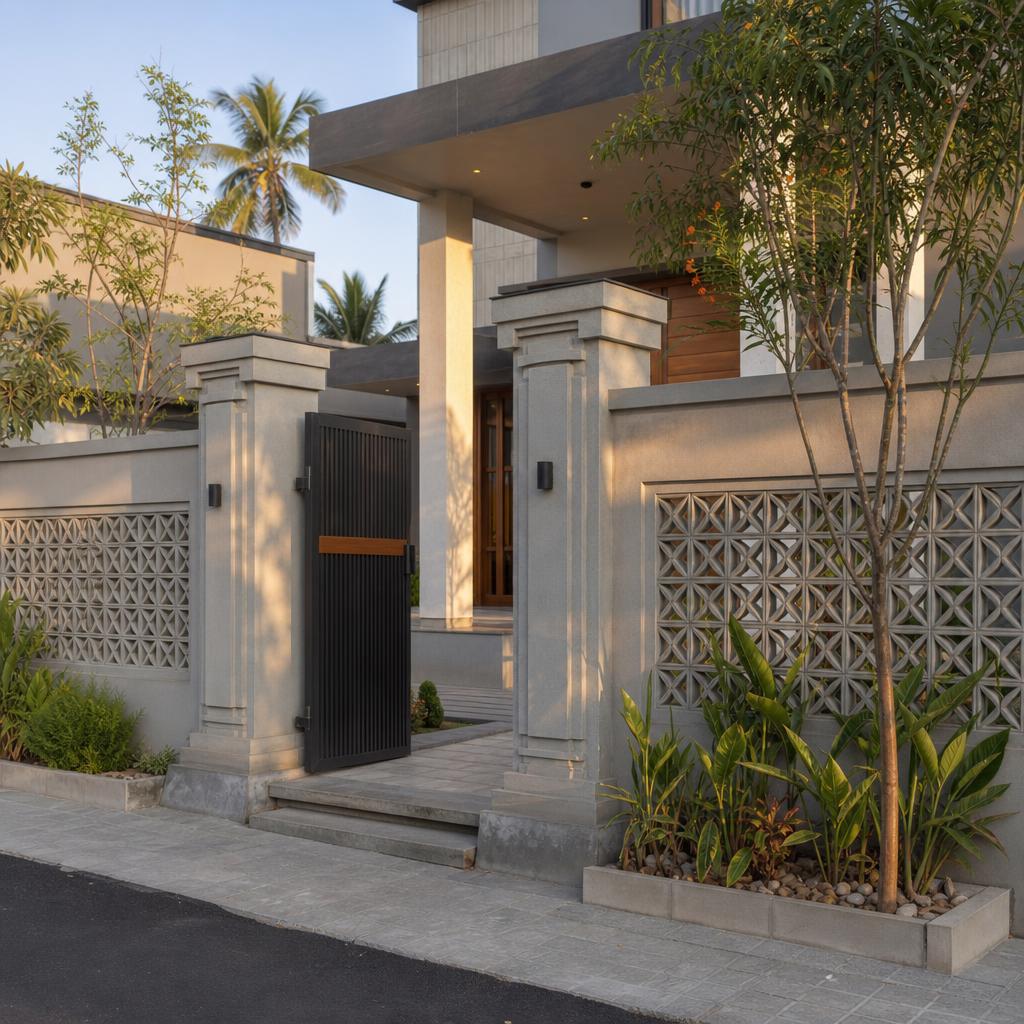
Design, size and placement for decorative cement planters
Selecting a decorative cement planter involves decisions about form, size, surface design and drainage — all of which need to be appropriate for the plant species, the position in the landscape and the visual character of the surrounding environment. A planter that looks excellent in isolation may look out of proportion in the intended position or inadequate for the plant species it is meant to contain. Planning the planter choice around the position and the plant is more satisfying than selecting a planter first and then finding something to put in it.
Form — square, rectangular or circular — is partly an aesthetic choice and partly a spatial choice. Square and rectangular planters align with walls, steps, paths and other rectilinear elements and are easier to arrange in coordinated pairs or series along a straight edge. Circular planters are more versatile in informal settings — they work well as freestanding landscape features without needing to align with other elements. For entrance positions where a pair of matched planters flank a gate or doorway, square or rectangular forms typically create a more formal and architectural effect than circular forms.
Size relative to the plant is a critical consideration. A small planter will limit the root development and therefore the growth and health of a large plant species. A very large planter will hold excessive moisture around small plant roots, leading to root rot in species that require good drainage. The internal volume of the planter should match the mature root ball of the intended plant species — not the current pot size, but the eventual mature root ball. We can advise on planter sizing for common Indian garden plant species when you discuss your order.
Wall thickness affects the structural durability and the internal volume of the planter. A planter with walls that are too thin is vulnerable to cracking under the freeze-thaw stress of cold winters in hill areas, the expansion of large root balls, and the impact stress of accidental knocks during maintenance. A planter with very thick walls is more robust but has less internal volume for the same external dimensions. We produce planters with wall thickness appropriate for the planter size and the intended application — larger planters have proportionately thicker walls for structural adequacy.
Drainage is non-negotiable for a plant container. Without adequate drainage, soil in a cement planter becomes waterlogged during the monsoon season and plant roots suffocate. Every planter we produce includes drainage holes at the base. The number and size of drainage holes is proportionate to the planter volume. When installing a cement planter on an impermeable surface (a tiled terrace, a concrete courtyard), place the planter on pot feet or a simple raised platform to allow the drainage holes to function freely and prevent standing water from accumulating under the planter and staining the surface below.
Surface design for decorative cement planters ranges from the purely material — smooth or textured cement — to the architecturally decorative, with relief patterns applied to the planter face. For planters that are placed as architectural elements at entrances and formal garden positions, a relief pattern that coordinates with the jali, pillar or railing design used elsewhere on the property creates visual coherence. For planters in informal garden areas where plants are the visual focus, a plain or lightly textured surface lets the plant be the star rather than the container.
Coordinating planters with other outdoor cemented elements is one of the ways a garden achieves a designed quality. When the planter surface references the jali pattern used on the boundary wall, or when the planter proportions echo the pillar profile used at the gate, the garden develops a material coherence that is immediately perceptible and gives the outdoor environment the quality of a designed space rather than an assembled collection of individual products. At Balodiya, we can advise on this coordination because we supply all the cemented elements a garden might use — planters, jali, pillars, benches and tiles — from the same production programme.
Placement of decorative cement planters should be considered before ordering, not after delivery. The position of each planter in the garden or at the entrance determines its required size, shape and visual priority. A planter at the focus of a main garden view needs to be larger and more decorative than one at the edge of a secondary pathway. A pair of matching planters at a formal entrance needs to be symmetrically placed and matched for size and finish. Thinking through the placement logic before ordering helps ensure that the planters you receive are right for every intended position.
Decorative cement planter types from Balodiya
Square planters: The most versatile form for formal and entrance positions. Available from 300mm x 300mm to 1000mm x 1000mm internal dimension. Plain, textured or relief-pattern face options. Suitable for compact plants at small sizes and large specimen shrubs or small trees at large sizes.
Rectangular planters: Long-format planters for window box, terrace edge and pathway border applications. Available in custom aspect ratios for specific planting positions. Often used in series along terrace edges and pathway sides for a coordinated planted edge effect.
Circular planters: Informal and versatile for freestanding garden positions. Available from 350mm to 900mm diameter. The circular form is more self-referential than square or rectangular and works as a standalone feature without needing alignment with surrounding elements.
Planter-bench combinations: Integrated planter and bench forms in a single precast unit. The planter flanks the bench seat and serves as an armrest and visual anchor. Available in the same leg profiles and surface treatments as our standard bench range.
Large landscape feature planters: Substantial planters for specimen planting — large shrubs, small trees, bamboo clumps or feature plant arrangements — at entrance, courtyard and resort positions. Custom sizes and surface designs developed for specific landscape briefs.
Six things to know before placing a decorative cement planter order
Match planter size to plant species
The internal volume of the planter should accommodate the mature root ball of the intended plant species — not its current pot size. A planter that is too small for a fast-growing species will need replacement within 2 to 3 years as the root ball expands. Discuss plant species when ordering and we will advise on appropriate internal dimensions.
Ensure drainage is functioning
After installation, test the drainage holes by watering the empty planter and confirming that water drains freely from the base. If placing on an impermeable surface, use pot feet or a raised base to prevent the drainage holes from sitting in accumulated water. Blocked drainage is the most common cause of plant failure in cement planters.
Use appropriate potting mix
Do not fill cement planters with compacted garden soil. Use a well-draining potting mix — typically a blend of coco peat, perlite and compost — that retains moisture without becoming waterlogged. Compacted soil drains poorly, causing the same problems as inadequate drainage holes in a dense-soil environment.
Place before filling with soil
Position the cement planter in its final location before filling with soil and planting. A filled cement planter is extremely heavy — potentially several hundred kilograms for a large specimen planter — and cannot be moved without specialist equipment. Plan the position carefully before beginning installation.
Coordinate pairs and series
When using planters in pairs (at an entrance) or in a series (along a terrace edge), order all pieces from the same production batch to ensure consistent size, surface quality and colour. Planters from different batches may have subtle but visible differences in surface texture or tone that are immediately apparent when pieces are placed side by side.
Maintain the exterior surface
The exterior of a cement planter benefits from an annual inspection and, if painted, a touch-up of any paint chips. Moss growth on the exterior is a cosmetic issue — remove it with a mild solution and a soft brush when noticed. Staining from soil run-off at drainage holes can be cleaned with a mild acid solution followed by thorough rinsing.
Standard and custom planters from Balodiya
To order decorative cement planters, share the required form (square, rectangular or circular), the internal dimensions needed for the intended plant species, the surface design preference (plain, textured or relief pattern), the finish (natural or painted) and the quantity and delivery location. If the planters will be placed alongside other cemented elements from our range, tell us — we can coordinate the surface design and proportions for maximum visual coherence.
Custom planter designs are available for specific architectural programmes or landscape design briefs. Custom work involves a design discussion, specification review and, for fully custom surface patterns, mould development before production begins. Contact us to discuss custom decorative cement planter projects for your property or development.
We supply decorative cement planters across Punjab, Rajasthan, Haryana and Himachal Pradesh. Contact us at +91 90414 58526 or balodiyacementedproducts.com to begin planning your planter order.
Decorative cement planter questions answered
What shapes and sizes are available for decorative cement planters?
We produce square, rectangular and circular planters in a range of sizes from small accent pieces (300mm) to large landscape feature pieces (1000mm and above). Custom sizes are available for specific requirements.
Do cement planters come with drainage holes?
Yes. All our cement planters include drainage holes at the base as standard. The number and size of drainage holes is proportionate to the planter volume. Always ensure drainage holes are functional after installation.
Can decorative cement planters be used indoors?
Yes, but cement planters are primarily designed for outdoor use. For indoor use, place a saucer under the drainage holes to catch water runoff and prevent floor staining. Ensure the floor can support the weight of the filled planter.
How heavy are cement planters when filled with soil?
Weight depends significantly on size. A medium square planter (500mm x 500mm) filled with potting mix and a plant can weigh 80 to 150kg. Large landscape feature planters can weigh 300kg or more when filled. Plan placement carefully and ensure the supporting surface has adequate load capacity.
Can cement planters be painted?
Yes. After proper curing, cement planters can be painted in any exterior-grade colour. Primer before the topcoat improves adhesion. For planters that will be watered frequently, use a moisture-resistant paint formulation to extend the paint life between repainting cycles.
Can you supply cement planters in matching sets?
Yes. We can supply planters in matched sets — same size, same surface design, same finish — produced from the same production batch for maximum consistency. This is recommended for entrance pairs and terrace series applications.
Are custom surface designs available for cement planters?
Yes. Custom surface relief patterns are available for specific design briefs. Custom pattern development involves a design discussion, specification review and mould development before production begins. Contact us to discuss custom planter designs.
Do you supply planters for resort and commercial landscape projects?
Yes. We supply decorative cement planters for resort gardens, hotel landscaping, commercial outdoor spaces and institutional campus developments. Large commercial planter orders are managed with production scheduling and delivery planning coordinated with the project installation timeline.
Looking for the right planter for your garden or entrance? Talk to us.
Share the position, plant species, preferred form and delivery location. Balodiya Cemented Products will help you choose a decorative cement planter that adds permanent beauty and architectural structure to your outdoor space.