
Cement Stair Railing That Completes the Architecture of Your Home
A staircase is one of the first architectural details people notice when they enter a home. The railing must offer safety and support, but it also frames the entire elevation with rhythm, shadow and proportion. Balodiya Cemented Products makes decorative cement stair railing for customers across North India who want the strength of precast construction combined with a handcrafted visual character that lasts for decades.
Cement railing with strength and decorative character
Our stair railing solutions are planned for straight flights, landing turns, terraces, entrance steps and courtyard staircases. Pattern, height, post spacing, top rail profile and fixing points are all discussed before production so the final result works with the staircase rather than looking like an afterthought. We use fiber-wire reinforcement and curing practices that support dependable handling, long-term outdoor use and a surface that ages gracefully in North Indian weather conditions.
Good cement stair railing is more than a safety barrier. It is an architectural element that communicates the quality and intention of the whole home. A beautifully designed railing at the entrance sets the tone for everything inside and outside. Our railing panels are available in traditional geometric, floral, lattice, grid and custom patterns — chosen to match or complement other cement elements on the property such as jali screens, boundary pillars and gate details.
- Main entrance staircases and porch steps
- Indoor stair openings with a traditional feel
- Terrace and roof access stairs
- Farmhouse, bungalow and temple elevations
- Commercial buildings and resort staircases
- Courtyard and garden step railings
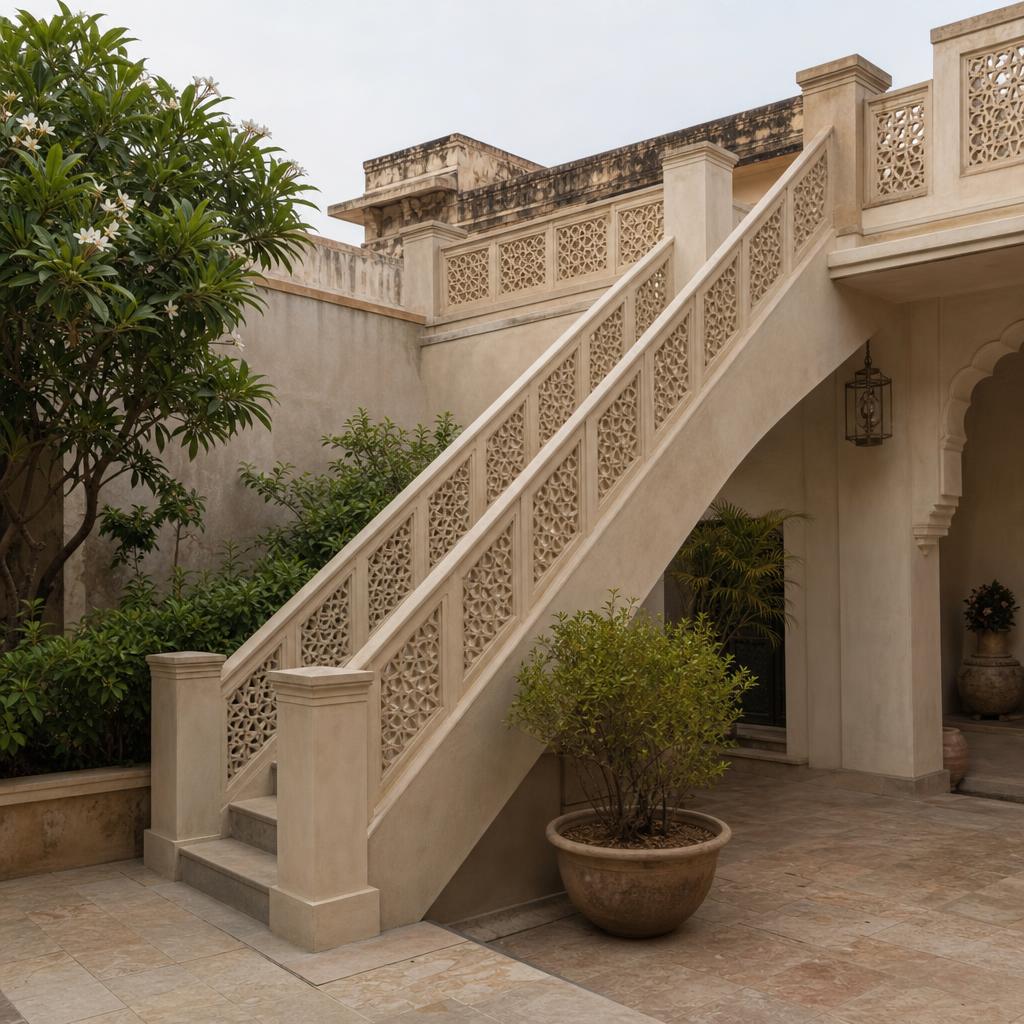
Why the right railing makes a staircase feel complete
A staircase without a well-designed railing looks unfinished, regardless of how well the steps themselves are built. The railing is the vertical element that frames the staircase from the ground, creates a visual rhythm along the flight and provides the physical guidance that makes a staircase feel safe and welcoming. For a main entrance staircase, this is especially important: the railing is visible from the road, judged by guests the moment they approach, and experienced through touch when people ascend and descend.
Cement stair railing offers specific advantages over iron, wood and aluminium alternatives. Iron rusts in humid conditions and requires ongoing repainting. Wood warps and rots under outdoor exposure in North Indian monsoon seasons. Aluminium looks appropriate in modern commercial settings but lacks the warmth and permanence expected in a traditional residential elevation. Cement, properly reinforced and cured, does none of these things. It weathers with dignity, does not require annual maintenance and can be painted to any colour the homeowner chooses.
The structural consideration for cement railing is different from iron. Cement is strong in compression but benefits from internal reinforcement when panels span openings or support lateral forces. Our panels include fiber-wire reinforcement that works with the cement matrix to absorb the kinds of stress a railing encounters — knocks, leaning, vibration from nearby vehicle traffic and the normal loads of people using the staircase. This reinforcement is invisible in the finished product but essential to its long-term reliability.
Measurement is the first critical step in any stair railing project. The staircase width determines the panel width. The riser height and tread depth affect the angle of the railing. The total flight height determines how many panels are needed and whether any panel needs to be cut or adapted to the angle. The landing dimensions, if any, affect the return sections of the railing. All of these measurements need to be shared accurately before production begins — errors at this stage are expensive to correct after the product is made.
Pattern selection for stair railing should consider the viewing distance and the height at which the pattern will be seen. Patterns that are too fine may look like a dark mass from across the road at night. Patterns that are too bold may overpower a narrow staircase or a house with a restrained architectural character. Our team can show reference patterns at scale before finalising the design, helping customers make an informed choice rather than committing to a pattern they have only seen in a small photograph.
Post spacing is another important decision. Posts that are too widely spaced leave long, unsupported railing panels that are more vulnerable to impact. Posts too closely spaced create a heavy, closed feel that blocks light and ventilation. We calculate post spacing based on panel weight, panel span, fixing method and the structural requirement of the staircase, then present the recommendation for the customer's review before production.
The top rail profile is the detail that people touch. A round top rail is comfortable but traditional. A flat coping gives a more contemporary feel. A profiled cap with a slight bevelled edge sheds rainwater and resists the accumulation of dust and debris. For outdoor staircases, a water-shedding top profile is genuinely practical, not just decorative. We discuss the top rail as part of the complete railing design, not as a minor afterthought.
After installation, the railing should be inspected at the base and top rail fixing points. Mortar should fill all fixing gaps properly. Any hollow sound at a post base suggests the fixing is incomplete and should be remedied before the staircase is put into regular use. Once fully cured and settled, the railing can be painted if desired. We recommend waiting a minimum of 28 days after installation before applying any surface coating to allow complete curing.
Cement stair railing versus other materials
When planning a stair railing, many customers compare materials on initial cost alone. This comparison often leads to a short-term decision that becomes expensive over time. Here is a practical comparison for North Indian conditions:
Cement railing: High initial quality when properly made, no rust, no rotting, paintable, permanent character, pairs naturally with traditional masonry, low maintenance after installation, can be repaired locally without specialist fabricators.
Iron railing: Flexible in design but requires annual repainting to prevent rust, corrodes at joints and bases, can be welded and adjusted on site but the welding creates visual inconsistency, requires professional painter to maintain.
Wooden railing: Warm aesthetic indoors, but warps and deteriorates under outdoor exposure, requires annual treatment or painting, susceptible to termites in many North Indian regions, not suitable for exposed outdoor staircases.
Aluminium railing: Rust-free but lacks the visual weight and warmth expected in traditional residential elevations, difficult to customise pattern without expensive fabrication, not as easily integrated with cement pillar and jali designs already present on the property.
For properties that already use cement jali, cement pillars or traditional masonry, cement stair railing is the most natural and architecturally consistent choice. It also allows the homeowner to coordinate patterns across the entire elevation — jali, railing and pillar using related design language — creating a property that looks designed rather than assembled from unrelated parts.
Six steps to a successful stair railing installation
Take detailed measurements first
Measure staircase width, riser height, tread depth, landing dimensions, total flight length and desired railing height before ordering. Share these with us along with photographs of the staircase from the front and side. Accurate measurements are the single biggest factor in a problem-free installation.
Choose a coordinating pattern
The railing pattern should coordinate with other cement elements on the property. If you have boundary jali in a geometric pattern, a complementary but not identical geometry in the railing creates visual cohesion. Avoid using completely unrelated patterns on the same elevation — it creates a confused impression that is difficult to correct later.
Prepare the installation base
The mason must prepare correct fixing pockets or base plates before the railing arrives. Understand the fixing method — mortar pocket, anchor bolt or surface bonding — and ensure the masonry is ready for each method. Improper fixing creates a railing that feels unstable and eventually fails structurally.
Handle with care on site
Cement railing panels are strong in their final position but can crack at edges if dropped or leaned incorrectly during unloading and transport on site. Use two people to handle each panel, keep them vertical and padded during transit, and set them down on soft material rather than hard ground. Damage in handling is the most common cause of early product failure.
Allow curing after installation
After the railing is fixed with mortar, do not apply paint or sealant for at least 28 days. Keep the installation area clear of vibration and impact during this period. The mortar and any new cement joints need time to reach full strength before they are subjected to the loads of regular use.
Maintain the surface annually
Once per year, inspect all panel faces, edges and post bases. Look for paint peeling, surface staining, moss growth and any chips at edges or corners. Touch up paint chips immediately to prevent moisture entry. Clear moss with a mild solution and a soft brush. Annual inspection is quick and prevents problems that would require panel replacement.
Patterns, sizes and applications at Balodiya
Our stair railing range is divided into ready-made designs and fully custom options. Ready-made designs are available in our catalogue of standard patterns at standard stair railing heights of 900mm and 1050mm. These can be produced relatively quickly and are suitable when the staircase dimensions fit our standard panel widths. Custom designs can be produced at any dimension and in any pattern — including patterns derived from the customer's reference photograph, sketch or architect drawing.
The most popular stair railing patterns from our workshop include traditional geometric lattice designs that pair naturally with Indian architectural styles, floral and botanical patterns that give a more decorative character, and clean grid or bar designs for customers who prefer a simpler visual. We also produce jali-inspired railing panels where the railing surface uses a perforated jali pattern rather than solid panels — creating a visual connection between the staircase railing and any boundary jali used elsewhere on the property.
For large projects — hotels, resorts, commercial buildings, apartment complexes — we can produce consistent railing panels in quantity with batch matching to ensure all panels on a long staircase or multiple staircase runs look uniform. Large project orders are managed with a production schedule that coordinates delivery with the installation sequence so the contractor does not need to store large quantities of panels on site.
Installation support is available for complex or large projects. Our team can visit the site before production to verify measurements, advise on fixing methods and review the masonry preparation. This pre-production site visit eliminates most of the risks that cause problems at the installation stage, particularly for custom-dimension or complex-angle staircase applications.
Contact Balodiya Cemented Products on +91 90414 58526 or through our website to discuss your stair railing project. We will ask the right questions, help you make the best pattern and dimension decisions, and produce a railing that becomes a permanent and appreciated feature of your property.
Stair railing questions answered
Can cement stair railing be used outdoors?
Yes. Properly reinforced, cured and installed cement railing is fully suitable for outdoor staircases, terraces, porches and courtyards. The material performs well in North Indian monsoon, summer and winter conditions when the product is correctly made and installed.
What measurements do I need to share?
Share the staircase width, number of steps, landing dimensions, riser height, desired railing height, total flight length and photographs of the staircase from the front and side. A site sketch is also helpful for complex or angled staircases.
Can the railing pattern match my existing boundary jali?
Yes. We can use an existing jali pattern or a complementary design as the basis for the railing. This creates visual coordination across the property elevation. Share photographs of your existing jali when making enquiries.
Is installation included in the supply?
Installation arrangements depend on location, quantity and site conditions. We provide detailed fixing guidance with every order. For complex projects, we can discuss site visit and installation support as an additional service.
How long do cement stair railings last?
A properly made and installed cement stair railing, maintained with basic annual care, should last 25 to 40 years or more without structural failure. Surface repainting every 5 to 7 years keeps the visual appearance fresh.
Can I get a custom height railing?
Yes. Standard heights are 900mm and 1050mm but we can produce any height to suit your staircase design. Custom heights are discussed at the order stage with no significant additional cost for most dimensions.
What is the lead time for cement stair railing orders?
Lead time depends on quantity, complexity and current workshop load. We discuss realistic timelines when you confirm your order and keep you informed during the production process.
Do you supply railing for both straight and curved staircases?
We primarily supply railing for straight staircases and landing returns. Curved staircase railings require special mould work and are assessed individually. Contact us with your staircase plan to discuss feasibility and cost.
Ready to plan your stair railing? Share your measurements.
Tell us your staircase dimensions, preferred pattern, finish and delivery location. Balodiya Cemented Products will help you choose a practical and beautiful cement railing that completes your home's architecture and lasts for decades.