
Custom Cement Jali for One-of-a-Kind Architectural Details
Standard jali patterns serve the majority of applications well, but some projects need something distinctly their own — a pattern derived from a family motif, a traditional craft design, an architect's drawing or a specific cultural reference that no catalogue product can provide. Custom cement jali from Balodiya Cemented Products is developed from your specific brief, produced with our 35 years of workshop expertise and delivered as a finished product with the same quality standards as our standard range — but with the pattern, dimensions and character that belong uniquely to your project.
Custom cement jali developed from your reference, sketch or design
Our custom cement jali process begins with whatever starting point the customer provides — a hand sketch on paper, a reference photograph, an architect's CAD drawing, a description of a traditional motif or a mood board of visual references that point toward a desired character. We analyse the starting point, identify the design decisions it implies — bar width, opening scale, pattern geometry, frame proportion — and develop a production specification that captures what the customer is responding to in the reference while making the necessary adaptations for cement production and the specific application dimensions.
Custom cement jali is appropriate when: no standard pattern in our range suits the architectural context, the project requires a distinctive identity that catalogue products cannot provide, the application has non-standard dimensions that require a new mould in any case, or the pattern needs to incorporate a specific motif — a traditional regional craft pattern, an architectural detail from an existing building that is being matched or extended, or a personal design element that is meaningful to the homeowner or client.
- Custom patterns from any reference
- Heritage and traditional motif development
- Architect drawing to production specification
- Non-standard dimensions and frames
- One-off designs for distinctive applications
- Repeat production from custom mould
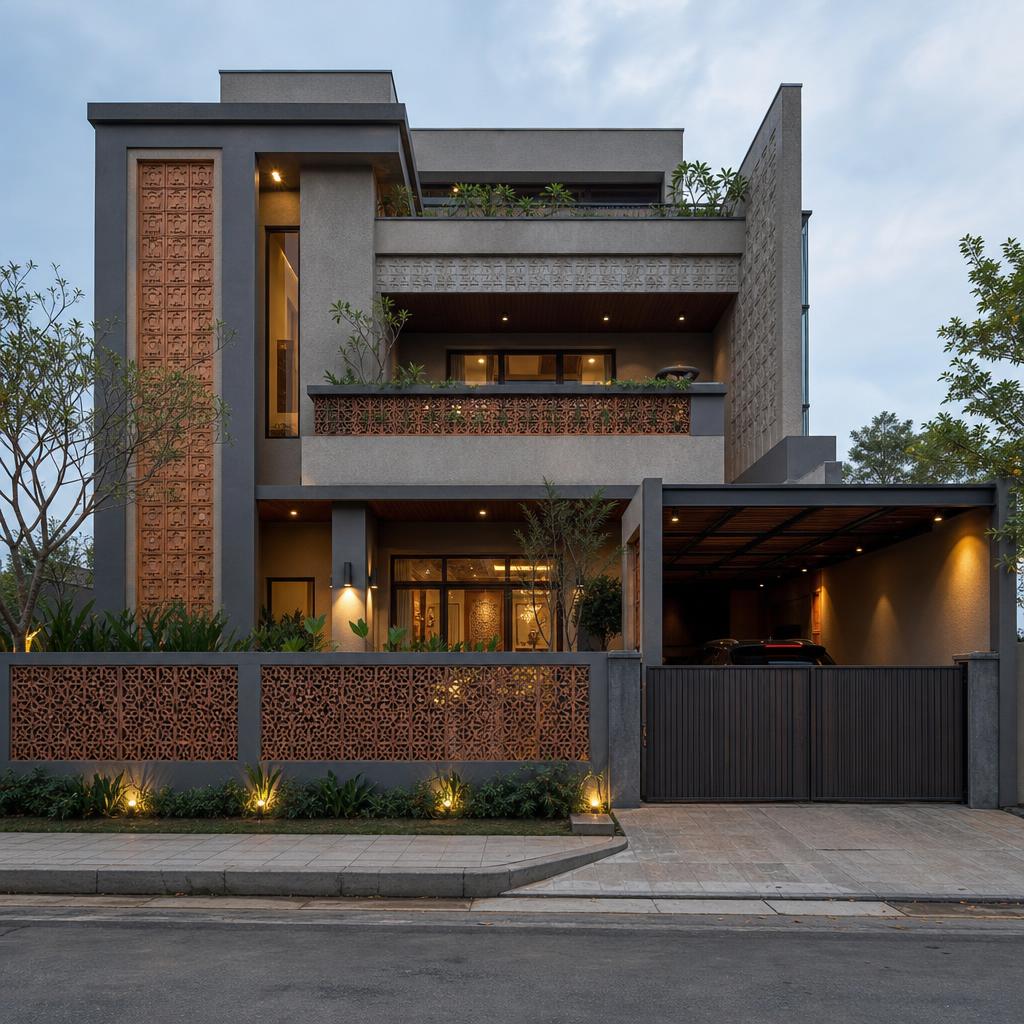
From brief to finished custom jali panel
The custom cement jali development process has five stages, each of which requires a clear exchange of information and decisions between the customer and our workshop. Understanding these stages helps customers plan realistic timelines and budgets for custom jali projects.
Stage 1: Brief and analysis. The customer shares the design starting point — reference photographs, sketches, drawings or descriptions — and we analyse what design decisions the reference implies. We identify the pattern geometry, the approximate bar width, the desired openness, the frame proportions and any specific motifs or details that must be preserved in the production version. We may ask questions to clarify what the customer most values in the reference — because what people respond to in a reference is not always the element they consciously notice first.
Stage 2: Specification development. From the brief analysis, we develop a production specification: the exact pattern geometry at the specific scale of the application dimensions, the bar width, the frame thickness, the panel depth, the reinforcement approach and any surface treatment. This specification is shared with the customer for review before any mould work or production begins. Changes at this stage are easy and inexpensive. Changes after mould production has begun are significantly more costly.
Stage 3: Mould development. Once the specification is approved, the mould for the custom pattern is developed. Mould development time depends on the complexity of the pattern and the dimension of the mould. Simple geometric patterns with a small number of repeating elements can be moulded relatively quickly. Complex curvilinear patterns with many individual element shapes require more careful mould construction. We provide a realistic timeline for mould development when confirming the specification and keep the customer informed as the mould progresses.
Stage 4: Sample production and review. For large custom jali orders — where the cost of mould development is amortised across many panels — we strongly recommend producing a sample panel before committing to full production. The sample panel allows the customer to see the pattern at actual scale and in the actual material, and to confirm that it matches the brief before production of the full quantity begins. Changes requested after sample review are incorporated into the mould before full production. This sample review stage is the most effective way to ensure the finished product matches the original vision.
Stage 5: Full production and quality inspection. Once the sample is approved, full production of the ordered quantity begins. Each panel is produced to the same specification, from the same mould, with the same mix and curing programme. Quality inspection before dispatch reviews each panel for dimensional accuracy, surface quality, edge condition and pattern fidelity. Panels that do not meet the standard are reworked or replaced before dispatch.
Custom jali applications from Balodiya
Heritage property restoration: Matching or extending existing jali patterns on heritage properties — havelis, colonial buildings, traditional courtyard houses — where the existing pattern must be matched precisely for visual continuity. Heritage restoration custom jali requires the most precise pattern development and sample review process.
Distinctive residential entrance: A custom jali pattern developed specifically for one property, giving it a visual identity that no other property in the neighbourhood shares. This is the most common residential application for custom jali — homeowners who want their boundary wall or entrance feature to look unmistakably theirs.
Architect-designed projects: Custom jali produced from architect drawings for designed residential and commercial projects where the jali is a specified element of the architectural design rather than an off-the-shelf component. We work with architects to translate design drawings into production specifications and manage the production as a sub-contractor to the construction programme.
Religious and institutional applications: Custom jali with traditional or culturally specific motifs for temples, dharamshalas, cultural centres and similar institutions. These applications often require patterns with a specific iconographic meaning or a connection to a particular craft tradition that standard catalogue patterns do not provide.
Commercial identity applications: Custom jali with geometric or graphic elements drawn from a commercial brand identity — for hotels, resorts, restaurants and retail spaces where the architectural detail is part of the brand experience.
Six things to know before commissioning custom cement jali
Start with a clear brief
The clearer the brief, the better the custom jali outcome. Share your reference materials, explain what you respond to in them, describe the application and its requirements, and tell us anything that is non-negotiable about the design. A clear brief leads to a precise specification; a vague brief leads to a product that may not match the customer's unspoken expectations.
Allow adequate lead time
Custom jali requires mould development time in addition to production time. Total project lead time from brief to delivered product typically ranges from 6 to 12 weeks depending on design complexity and mould development requirements. Plan your construction schedule to allow this lead time — custom jali cannot be produced in the same timeframe as stock items.
Invest in the sample review stage
The sample panel review is the most effective way to ensure the finished product matches the brief. The cost of a sample panel is small relative to the cost of producing an incorrect full batch. Approve the sample, not just the specification drawing — cement, scale and light behave differently from paper, and the sample is the only reliable preview of the finished installation.
Consider producibility when designing
Not every pattern that can be drawn can be cast in cement. Very thin bars (under 15mm) are extremely fragile and prone to breakage. Very complex curvilinear intersections may be difficult to de-mould cleanly. Overhanging profile elements may require complex two-part moulds. Share your design ideas with us early — we can advise on producibility before significant design investment is made in an impractical direction.
Order enough for installation damage and future replacement
Custom jali cannot be quickly reordered if a panel is damaged during installation or in use — the mould must be set up again and the lead time repeats. Order 10 to 15 percent above the installed quantity to have spares available. If the mould will be retained for future reorders, this cushion can be smaller.
Discuss mould ownership and retention
For custom jali with a unique pattern, discuss mould ownership and retention with us at the ordering stage. A retained mould allows future reorders to be produced at production cost without the mould development premium. Mould retention for an agreed period protects the investment in custom pattern development for ongoing or phased projects.
What to expect when commissioning custom cement jali
Custom cement jali pricing includes three components: the mould development cost (a one-time charge that depends on pattern complexity), the per-panel production cost (similar to standard jali at comparable dimensions and specification) and the delivery cost (the same as for standard jali). For large orders, the mould development cost per panel is low. For small orders or single-panel commissions, the mould development cost is a larger proportion of the total project cost.
Timeline expectation for custom cement jali: brief development and specification takes 1 to 2 weeks; mould development takes 2 to 4 weeks depending on complexity; sample production and review takes 1 week; full production takes 2 to 4 weeks depending on quantity; total project lead time from confirmed brief to delivered product is typically 6 to 12 weeks for most custom jali projects. Projects with very complex patterns or large quantities may require longer timelines. We provide a specific timeline estimate when the specification is confirmed.
Contact us at +91 90414 58526 or balodiyacementedproducts.com to begin the conversation about your custom cement jali project. Whether you have a detailed architect drawing or a rough sketch on paper, we can develop a producible cement jali design from your starting point and manage the production from brief to delivery.
Custom cement jali questions answered
What design starting point do I need to commission custom cement jali?
Any starting point is workable — a sketch on paper, a reference photograph, an architect's drawing, a description of a traditional motif or a mood board of visual references. The clearer and more specific the starting point, the more precise the development process. We work with whatever level of detail you can provide.
Can Balodiya match an existing jali pattern from my property?
Yes. For heritage restoration or extension projects, we can develop a production pattern that matches an existing jali as closely as the material and production method allows. This typically requires a detailed study of the existing pattern — either through a site visit or through detailed photographs and measurements.
Is a sample panel required before full production?
We strongly recommend a sample panel review for all custom jali orders. The sample allows you to see and approve the pattern at actual scale and in actual cement before committing to full production. Requesting a sample review is the customer's choice, but skipping it increases the risk of a finished product that does not match expectations.
How is the mould cost calculated for custom cement jali?
Mould cost depends on pattern complexity and mould dimensions. Simple geometric patterns with few element shapes are less expensive to mould than complex curvilinear patterns with many individual elements. We provide a specific mould cost estimate when we review the design brief and before confirming the order.
Who owns the custom mould after production?
Mould ownership is discussed and agreed at the ordering stage. Typically, the mould remains at our workshop for future reorders. For clients who want exclusive ownership or require the mould to be transferred to another production facility, we discuss the arrangement before the order is confirmed.
Can custom cement jali be produced in very small quantities?
Yes, but the economics of small quantities for custom jali reflect the full mould development cost spread across fewer panels — making the per-panel cost higher for small orders than for large ones. We discuss minimum viable quantities for custom jali projects when reviewing the brief and budget.
Can you work with an architect's CAD drawing for custom jali production?
Yes. Architect CAD drawings are the most precise starting point for custom jali production. We can translate a CAD pattern into a production specification directly, with confirmation of any adaptations required for cement production constraints.
What is the total timeline for a custom cement jali project?
Typically 6 to 12 weeks from confirmed brief to delivered product, depending on pattern complexity, mould development requirements and production quantity. We provide a specific timeline estimate for your project when the specification is confirmed.
Have a unique jali idea? Bring it to us — we will make it happen.
Share your reference, sketch or design brief. Balodiya Cemented Products will develop a custom cement jali from your starting point and produce it to the quality standard that 35 years of jali production expertise allows.