
Cement Jali Price: What Changes the Final Project Cost
Understanding what affects cement jali price helps you plan your project budget accurately and compare quotes intelligently. The price of cement jali is not a single number — it varies with panel size, pattern complexity, bar thickness, reinforcement, frame design, quantity, surface finish and delivery distance. This guide explains each factor honestly so you can make informed decisions and avoid the common trap of choosing the cheapest option and discovering the quality problem only after installation.
The factors behind cement jali price at Balodiya
At Balodiya Cemented Products, we price cement jali based on the actual cost of production: material quantities, mould time, labour, curing and quality inspection. We do not inflate prices artificially or cut corners to achieve a lower quote. When a quote seems unusually low for the specification, it is usually because the reinforcement has been reduced, the curing shortened, the mix quality compromised or the inspection skipped. These shortcuts are invisible at the time of purchase and visible only after installation, when the problems begin to appear. Our pricing reflects the cost of producing jali that performs as intended for the full life of the installation.
For customers comparing quotes, the most useful comparison is not between the bottom-line price numbers but between the specifications behind the quotes. Same panel size? Same mix grade? Fiber-wire reinforcement included? Same frame thickness? Same curing period? Same surface finish? When the specifications are genuinely comparable, the price comparison is meaningful. When the specifications differ, comparing the price alone tells you nothing about relative value.
- Panel size is the largest price driver
- Pattern complexity affects mould cost
- Bar thickness affects material quantity
- Quantity discounts apply to repeat orders
- Custom dimensions add to production cost
- Delivery distance affects final price
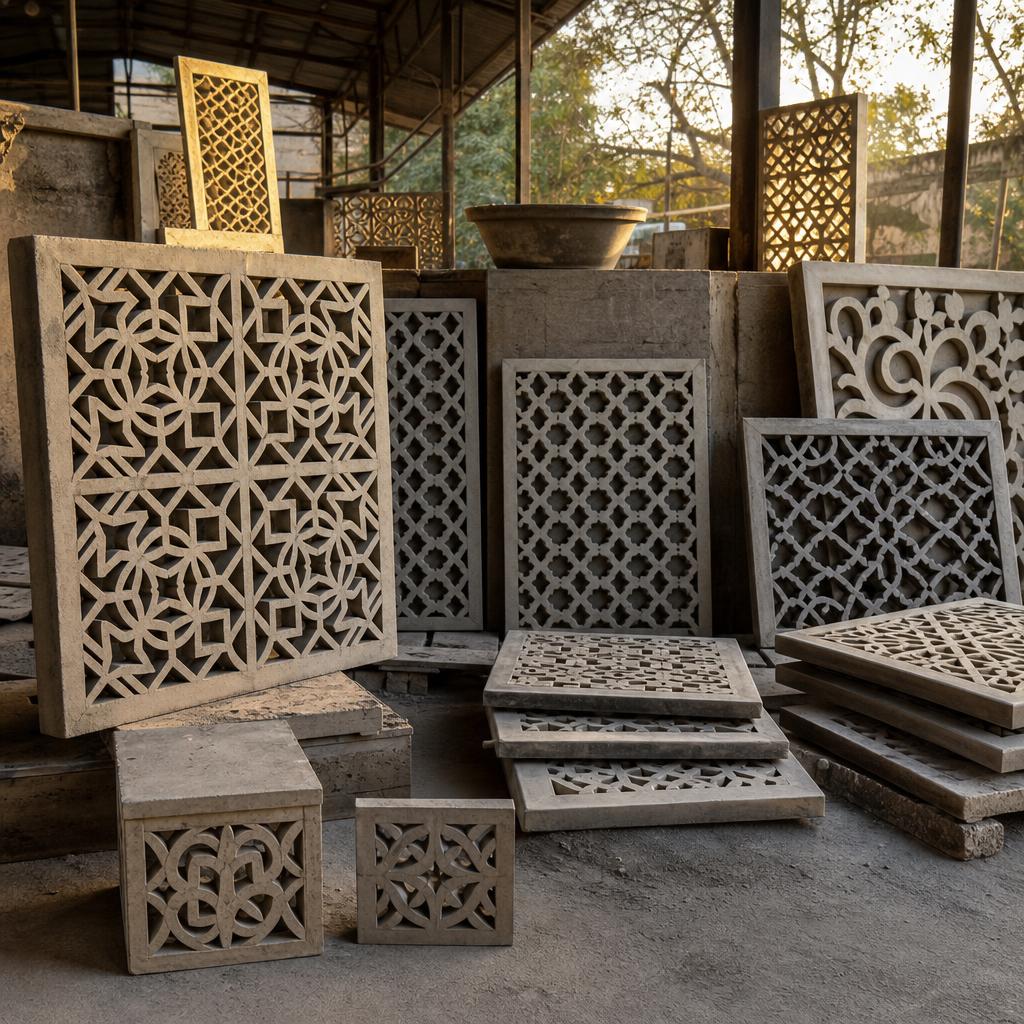
A detailed breakdown of every price factor
Cement jali price is determined by a combination of factors that interact in ways that are not always obvious to buyers who have not purchased jali before. Understanding each factor separately helps you build a budget that reflects what you actually need, and helps you have a productive conversation with the supplier about what can be adjusted if the initial quote is above budget.
1. Panel size
Panel size is the largest single determinant of cement jali price. A larger panel requires more cement mix, more reinforcement material, a larger mould, more production labour per panel, more curing space and more transport weight. Price typically scales roughly with panel area — a panel that is twice the area of a smaller panel will cost approximately twice as much, all other factors being equal. For the same total wall area, ordering fewer large panels is usually more economical than ordering many small panels because the frame proportion (which uses more material per unit of pattern area) is lower in larger panels.
2. Pattern complexity
Pattern complexity affects the cost of the mould required to produce the pattern and the production time per panel. Simple geometric patterns — diamond, square grid, hexagonal — use moulds that can be produced at relatively low cost and maintained for many production cycles. More complex curvilinear patterns — arabesque, botanical, custom designs — require more intricate mould construction and more careful production management. The mould cost for a complex pattern is typically amortised across the quantity of panels ordered — so a large order of complex-pattern panels has a lower per-panel premium for pattern complexity than a single-panel custom order.
3. Bar thickness and pattern density
Thicker bars use more cement material and require larger, more robust moulds. A fine-bar jali (20 to 25mm bar width) uses less material per panel but requires more careful production and more precise mould work than a medium-bar jali (40 to 50mm bar width). Counterintuitively, fine-bar jali can sometimes be more expensive to produce than medium-bar jali despite using less material, because the production precision required is higher. Pattern density — the ratio of solid bar area to open area — directly affects material quantity and therefore price: a denser pattern uses more cement than a more open pattern of the same size.
4. Frame design and thickness
The frame surrounding the jali pattern is a significant contributor to both material quantity and visual quality. A wider frame (100mm or more on each side) uses more material and costs more to produce than a minimal frame (50mm) but provides much better structural integrity, easier handling and a more architectural visual quality. Frames with profiled edges or moulded details require more mould complexity and production care than plain-face frames. The frame design is a genuine cost driver and should be specified based on the structural and visual requirements of the application, not just on the desire to minimise price.
5. Panel thickness (depth)
Thicker panels use more material and therefore cost more. Standard jali panel thickness ranges from 75mm to 150mm. Thicker panels create richer shadow effects, are more robust in handling and installation, and perform better in applications where the jali will be experienced from close range. Thinner panels are adequate for many standard applications and produce cost savings that are meaningful on large orders. Specify the appropriate thickness for the application — not the minimum possible thickness — as a panel that cracks in installation or fails to perform structurally costs far more than the saving on panel thickness justified.
6. Reinforcement type
All Balodiya jali panels include fiber-wire reinforcement as standard. This is not always true of the market. Some suppliers offer unreinforced panels at lower prices — panels that may look identical at the time of purchase but are significantly more vulnerable to transport damage, installation cracking and long-term performance problems. When comparing quotes, confirm explicitly whether reinforcement is included and what type. The cost of reinforcement in a jali panel is a small fraction of the total panel cost — a supplier who saves on reinforcement to reduce the quote is making a significant quality compromise for a minor cost saving.
7. Surface finish
Natural cement finish (as-cast, with a light surface wash) is the least expensive finish option. Painted finish requires additional surface preparation and paint material cost but creates a more finished visual appearance. Specialist finishes — aggregate exposure, acid-wash, colour stain — require specific production steps that add to cost. The finish choice should be driven by the design intent and maintenance philosophy of the project, not purely by the desire to minimise price.
8. Quantity
Larger orders typically benefit from quantity pricing. The fixed costs of mould setup and production preparation are spread across more panels, reducing the per-panel cost. For large boundary wall jali projects — 20, 50 or 100 panels of the same design — the quantity pricing can be significant. Discuss quantity with us before finalising the order — sometimes ordering slightly more than the immediate requirement, to have spares for installation damage or future replacement, makes sense when the per-panel saving from a larger quantity order is considered.
9. Custom dimensions
Custom dimensions require either mould adaptation or new mould production. A slight size adjustment — adding or subtracting 50mm to an existing mould dimension — requires minimal additional cost. A significantly different size or aspect ratio may require a new mould, which adds a one-time mould cost to the order. For large orders with consistent custom dimensions, the per-panel mould cost is low. For single-panel custom orders, the mould cost is more significant relative to the panel price. Discuss custom dimension requirements and their cost implications when planning your order.
10. Delivery distance and logistics
Delivery cost depends on the distance from our workshop in Sri Muktsar Sahib (Punjab) to the project site, the quantity and weight of the order, the transport method required and any special handling needs for large or fragile panels. For local deliveries in Punjab, transport cost is relatively low. For deliveries to Rajasthan, Haryana or Himachal Pradesh, transport cost adds more significantly to the final project cost. For very large orders, we can sometimes arrange more economical bulk transport. Discuss delivery logistics when requesting a quote — the delivery cost should be part of the complete project budget calculation, not an afterthought.
| Price factor | Low cost direction | Higher cost direction | Impact on quality |
|---|---|---|---|
| Panel size | Smaller panels | Larger panels | Neutral — choose by application |
| Pattern complexity | Simple geometric | Custom curvilinear | Aesthetic difference only |
| Bar thickness | Thicker bars (less precise) | Fine bars (more precise) | Fine bars more fragile to handle |
| Frame thickness | Minimal 50mm frame | Full 100mm frame | Wider frame = better structural integrity |
| Panel depth | 75mm minimum | 150mm deep panel | Deeper = richer shadows, more robust |
| Reinforcement | Unreinforced (avoid) | Fiber-wire included | Reinforcement critical for durability |
| Quantity | Large orders | Single panels | Neutral — cost only |
| Custom dimensions | Standard sizes | Custom dimensions | Neutral — fit application better |
Six ways to get the best value on your cement jali project
Specify before comparing
Define your complete specification — panel size, pattern, frame thickness, depth, reinforcement, finish — before requesting quotes. Quotes to the same specification are comparable. Quotes to different specifications are not and lead to the false economy of choosing the cheapest quote for a product that is not what you needed.
Order the right quantity
Calculate the total panel quantity required, add 5 to 10 percent for installation damage and future replacement, and order the full amount in one batch. Quantity pricing applies to larger orders and ensures consistent quality across the installation. Reordering small supplementary quantities later is more expensive per panel and may not match the original batch.
Choose standard sizes where possible
Standard panel sizes avoid the mould adaptation cost of custom dimensions. Before specifying a custom size, check whether a standard size can be accommodated by adjusting the wall opening or the frame clearance slightly. The saving on mould cost for standard sizes is real and can be significant for small orders.
Do not compromise on reinforcement
If a quote is lower than expected, ask explicitly whether fiber-wire reinforcement is included. Unreinforced jali is cheaper to produce but significantly more likely to crack in transport, installation and long-term use. The saving on reinforcement is a quality compromise that costs more in the long run than the initial saving was worth.
Plan delivery in one trip
Consolidating deliveries reduces transport cost per panel. If the project requires panels for multiple locations — boundary wall, balcony and staircase — order all panels together and deliver in one trip rather than requesting separate deliveries for each group. The transport saving on one consolidated delivery can be significant.
Get the full cost including installation
The cement jali price is one part of the total project cost. Installation labour, mortar materials, any scaffolding required and the mason's time to prepare the openings are all additional costs. Understand the full project cost — supply plus installation — before fixing a budget, so the budget allocation between product and installation is realistic.
How to request a quote that gives you a useful answer
To get a useful cement jali price from Balodiya Cemented Products, share: the application (boundary wall, balcony, staircase or other), the wall opening dimensions or the required panel dimensions, the preferred pattern (with a reference image if possible), the required panel depth, the quantity and the delivery location. With this information we can prepare a specific, honest quote that covers the product to the right specification for the application.
If your budget is a concern, share it with us. We can often suggest adjustments — a slightly different pattern scale, a standard size close to your custom requirement, a slightly thinner frame where structurally acceptable — that bring the project within budget without making significant quality compromises. A supplier who helps you achieve the best result within your actual budget is more valuable than one who either refuses to discuss budget or reduces quality without telling you why the price is lower.
Contact us at +91 90414 58526 or balodiyacementedproducts.com to request a cement jali price for your specific project. We serve customers across Punjab, Rajasthan, Haryana and Himachal Pradesh and price every order transparently based on the actual cost of production.
Cement jali price questions answered
What is the typical price range for cement jali panels?
Cement jali price varies significantly with size, pattern, depth and quantity. Share your specific requirements and we will give you an honest, itemised quote. We do not publish standard price lists because the price correctly varies with the specification — a single price range would be misleading.
Why is some market jali much cheaper than yours?
Lower market prices usually reflect reduced reinforcement, shorter curing, lower mix quality, thinner frames or skipped quality inspection. These compromises are invisible at purchase but visible within the first monsoon season as cracking, chipping and surface deterioration. Our price reflects the cost of making jali that performs for the full life of the installation.
Does the pattern choice affect the price?
Yes. Simple geometric patterns (diamond, square grid) use less complex moulds than curvilinear custom patterns. For standard patterns in our range, the pattern premium is modest. For fully custom patterns requiring new mould development, there is a one-time mould cost that is spread across the order quantity.
Is reinforcement included in your quoted price?
Yes. Fiber-wire reinforcement is standard in all Balodiya jali panels and is included in our quoted price. We do not offer unreinforced panels as a lower-cost alternative — reinforcement is not optional in our production.
Does delivery cost change with distance?
Yes. Delivery cost depends on the distance from our workshop in Sri Muktsar Sahib, the panel quantity and weight, and the transport method required. We include a delivery estimate in our quotes based on the delivery location specified. Consolidated deliveries of larger quantities are more economical per panel.
Is there a quantity discount for large jali orders?
Yes. Larger orders benefit from quantity pricing as the fixed production costs are spread across more panels. Discuss your total project quantity when requesting a quote — the per-panel price for a 50-panel boundary wall order will be different from a 5-panel balcony order.
Can I get a quote for custom-size jali panels?
Yes. Share the custom dimensions and we will quote including any mould adaptation cost. For custom sizes close to our standard mould dimensions, the adaptation cost is minimal. For significantly different dimensions, a new mould may be required with a corresponding one-time cost.
What information do I need to provide for an accurate cement jali price?
Application, wall opening dimensions or required panel dimensions, preferred pattern, required panel depth, reinforcement requirement (fiber-wire standard), surface finish preference, quantity and delivery location. The more complete the specification, the more accurate and comparable the quote.
Ready for an honest cement jali price? Share your project details.
Tell us your application, dimensions, pattern preference, quantity and delivery location. Balodiya Cemented Products will give you a transparent, itemised quote that reflects the actual cost of quality-made cement jali for your specific project.