
Cemented Pillars and Pillar Designs for Distinctive Home Elevations
Cemented pillars define the character of a home's entrance more than almost any other single architectural element. A well-designed and properly made cement pillar communicates quality, permanence and attention to detail to anyone who sees the property. Balodiya Cemented Products has been making cemented pillars for entrance gates, boundary walls, porches and architectural elevations across North India for over 35 years.
Cement pillar design that reflects the quality of your home
Our cemented pillars are made in sections — base plinth, shaft body and capital — that assemble on site to create a complete pillar at any required height. This sectional approach allows one set of moulds to produce pillars of different heights by varying the number of shaft sections, which makes custom heights both practical and economical. Surface profiles range from plain square and octagonal to decoratively moulded classical profiles with fluting, banding and panel details.
A cemented pillar at an entrance gate is seen from the road. It carries the visual weight of the entire property's first impression. When a pillar looks substantial, well-proportioned and well-finished, the whole property benefits from that impression. When the pillar is thin, roughly finished or out of proportion with the gate opening, even a beautifully designed home behind it looks less impressive. Proportion, profile and finish are the three decisions that determine whether a pillar achieves its visual purpose.
- Entrance gate pillars and post systems
- Boundary wall pillar spacing and capping
- Porch and veranda pillar columns
- Architectural feature pillars for facades
- Temple and institutional pillar designs
- Custom pillar systems for any application
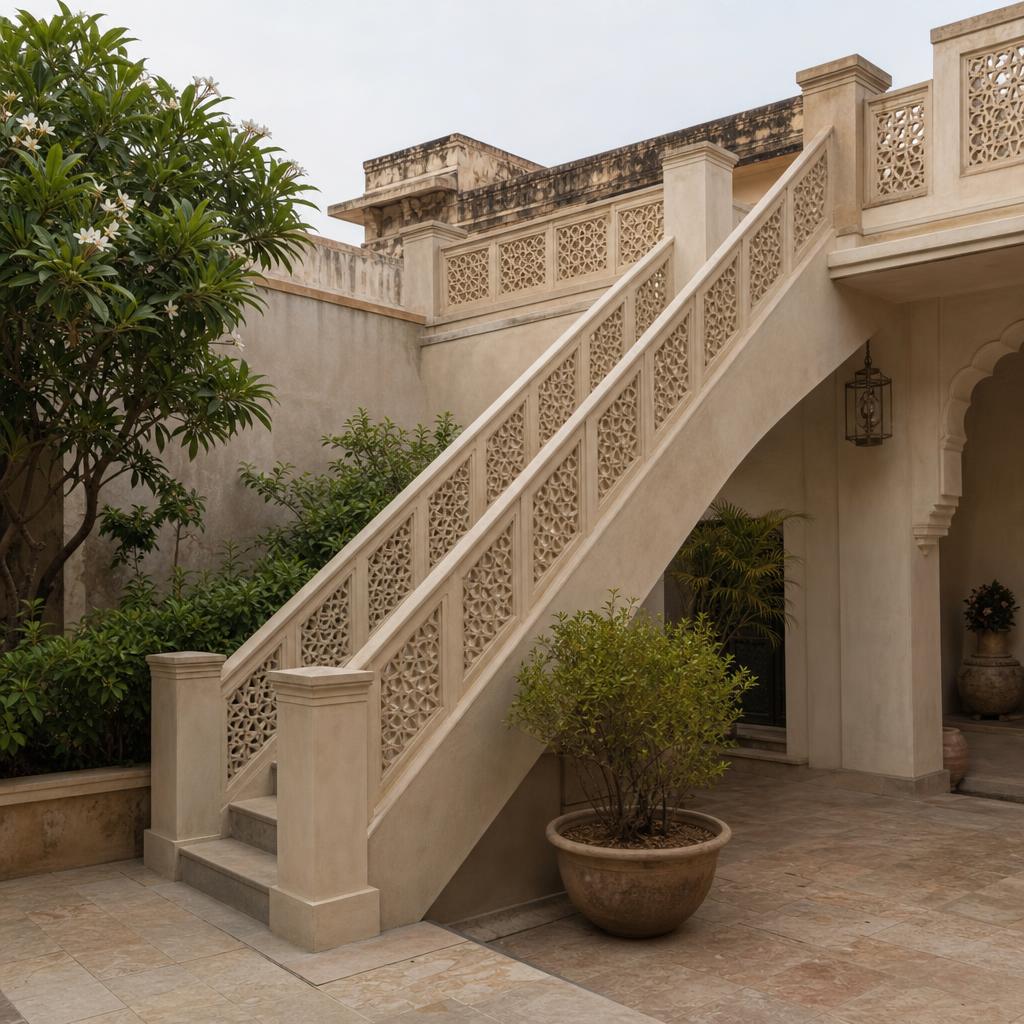
The principles behind a well-designed cement pillar
Pillar design is one of the oldest disciplines in architecture. Every major architectural tradition — Greek, Roman, Mughal, Rajput, colonial — developed its own vocabulary of pillar profiles, proportions and capital designs. North Indian domestic architecture has inherited a blend of these traditions, adapted through centuries of practice into a regional style that uses pillars at gates, porches, boundary walls, courts and corridors. Understanding this context helps in choosing a pillar design that feels at home in the local architectural environment rather than looking imported or arbitrary.
The most important design decision is overall proportion. A pillar's height-to-width ratio determines whether it looks slender and elegant or stocky and grounded. For entrance gate pillars, a taller, more slender pillar makes the gate opening feel generous and the entrance feel welcoming. For boundary wall pillar spacers, shorter, wider proportions coordinate better with the wall height and create a rhythmic pattern along the boundary that reads clearly from the street.
Profile is the second decision. A plain square profile is clean and works in almost any context. An octagonal profile adds subtle interest without committing to a specific historical style. A classically profiled pillar with base mouldings, fluted shaft sections and a capital adds decorative richness appropriate for more formal or traditional homes. The profile should match the architectural character of the building the pillar will serve — a contemporary flat-roofed home suits a simpler pillar profile than a traditional porch or a heritage-influenced bungalow.
Capital design is the decorative crown of the pillar and the most visible surface detail when seen at close range. Capitals can be simple flat coping stones (appropriate for boundary wall pillars), stepped moulded profiles (for more formal gate pillars), or fully decorated bracket capitals with relief pattern (for porch or veranda columns where the detail is seen up close and from below). We produce capitals in a range of profiles to match different pillar shaft designs and home styles.
Base plinth design anchors the pillar visually. A base plinth that is wider than the pillar shaft provides a visual base that makes the pillar look grounded and stable. The base plinth also serves a practical function: it provides a level, square surface for the mason to set the pillar on and provides a small step-back that prevents water from running down the shaft and pooling at the base joint. A well-designed base plinth is as important as the capital in determining how the pillar reads.
Surface finish for cemented pillars typically follows one of two approaches: painted or natural. Natural cement with a light surface treatment — a wash or colour stain — shows the material quality of the product and works well in properties where exposed concrete and cement surfaces are part of the design language. Painted pillars are more common in traditional residential applications and allow the homeowner to refresh the appearance periodically or change the colour scheme of the property without changing the pillar structure.
Reinforcement in cemented pillars is essential for taller or free-standing applications. Our pillar sections are made with fiber-wire reinforcement as standard. For tall gate pillars that carry decorative lantern brackets or gate-hanging hardware, additional structural consideration is given at the production stage. We discuss reinforcement requirements based on the pillar's height, its load and its exposure to wind and vibration from nearby vehicle traffic on gates.
The assembly process on site requires careful preparation. The foundation for a gate or entrance pillar must be adequate for the pillar's height and weight. A foundation that is too shallow or too narrow will allow the pillar to tip or shift over time. The mason should prepare the foundation and confirm it is set and level before the first pillar section is placed. We provide foundation guidance with every pillar order and encourage customers to share the pillar dimensions with their structural engineer for tall or heavily loaded pillar applications.
Cemented pillar applications at Balodiya
Entrance gate pillars: The most prominent application. Gate pillars support the gate hardware, frame the entrance and create the first architectural impression. Pillar height, profile and capital design are all critical for this application. We commonly supply entrance gate pillars in heights from 1800mm to 3600mm depending on gate size and property scale.
Boundary wall pillars: Pillars spaced along a boundary wall add rhythm, break the monotony of a long flat wall and provide structural stiffening at regular intervals. Boundary wall pillar designs are typically simpler in profile than gate pillars but should still coordinate visually with the gate pillar design.
Porch and veranda columns: Used to support a roof or shade structure, porch columns are seen close up and can carry more decorative detail than boundary wall pillars. The capital design for a porch column should be chosen to relate to the ceiling and roof detail above as well as the floor and steps below.
Interior architectural pillars: Used in courtyards, large interior spaces and double-height rooms as architectural features. These pillars are typically more refined in finish since they are experienced at very close range in good light. Surface smoothness, edge sharpness and dimensional accuracy are more critical for interior than exterior applications.
Six principles for the right cemented pillar design
Proportion before decoration
Get the pillar height-to-width ratio right before deciding on surface decoration. A well-proportioned pillar with a simple profile looks better than a poorly proportioned pillar with elaborate surface decoration. Proportion is the first quality that the eye judges, even before it processes the surface pattern.
Match the profile to the home
Choose a pillar profile that coordinates with the architectural character of the home. Contemporary homes suit clean, simple profiles. Traditional homes suit more elaborate moulded profiles with base and capital detail. Heritage or temple applications may need custom profiles with specific historical references.
Prepare a proper foundation
A cemented pillar is only as good as its foundation. Before ordering, confirm the foundation depth and width with your mason. For gate pillars that support heavy gates, discuss foundation requirements with a structural engineer. A pillar that leans or sinks within the first year is a foundation problem, not a product problem.
Coordinate with jali and railing
A gate pillar that coordinates visually with the boundary jali, gate railing and any decorative elements on the facade creates a more unified and architecturally coherent property elevation. Use related patterns, proportions or surface treatments to connect the different cemented elements into one visual system.
Plan the gate hardware early
If the pillar will carry gate hinges, lantern brackets, address plates or surveillance hardware, plan the fixing requirements before production. Hardware brackets embedded during casting are far stronger than surface-fixed brackets applied to a finished pillar. Share hardware specifications when ordering.
Paint after full curing
Allow the pillar sections to cure fully after installation — a minimum of 28 days — before applying any paint or surface treatment. Paint applied to uncured cement traps moisture and causes paint failure. After curing, prepare the surface with a light prime and apply two coats of good quality exterior paint for a finish that lasts 5 to 7 years without significant touch-up.
What to share when ordering from Balodiya
To produce the right cemented pillar for your project, we need: the application (gate, boundary wall, porch or other), the required height, the preferred cross-section size, the preferred profile (plain, octagonal, moulded), the capital design, the base plinth size, the quantity, the finish preference and the delivery location. If you have a reference photograph, share it. If you have an architect drawing or a dimension sketch, even better.
For gate pillar orders, we also ask about the gate type — whether it is a swing gate or a sliding gate — and whether the pillar will carry the gate hardware directly. Swing gate hardware creates lateral forces on the pillar and requires appropriate structural consideration. Sliding gates exert very little force on the pillar directly but the track foundation near the pillar needs careful planning.
Production time for standard pillar designs is typically 2 to 4 weeks depending on quantity and current workshop load. Custom profiles that require new mould preparation take longer and we discuss the timeline clearly before confirming the order. We do not rush production for pillars — the curing stage is particularly important for elements that will carry structural loads and need to perform for decades.
Balodiya Cemented Products supplies cemented pillars to customers across Punjab, Rajasthan, Haryana and Himachal Pradesh. Contact us on +91 90414 58526 or through our website to discuss your pillar project. We will help you choose the right design, proportion and finish for a cemented pillar that becomes a lasting and admired part of your property's architecture.
Cemented pillar questions answered
What heights are available for cemented gate pillars?
Our pillar sections can be assembled to virtually any height. Common gate pillar heights range from 1800mm to 3600mm. For taller applications, we discuss structural reinforcement and foundation requirements to ensure the pillar is safe and stable.
Can cemented pillars be made in custom profiles?
Yes. We produce pillars in square, octagonal and moulded profiles as standard. Custom profiles — for heritage restoration, temple construction or specific architectural requirements — can be developed with new mould preparation. Contact us to discuss feasibility and lead time.
Are the pillar sections hollow or solid?
Most pillar sections are produced with a solid or near-solid cross-section. Hollow sections may be used for very large diameter pillars where weight is a concern. We discuss the appropriate section design based on the pillar application and height.
Can gate hardware be fixed to cement pillars?
Yes. Hardware brackets can be embedded during casting for the strongest result. Surface-fixed hardware is also possible but less robust. Share your gate hardware specifications when ordering so we can plan the appropriate fixing system.
How are cemented pillar sections joined on site?
Sections are joined with a strong mortar bed and, for tall pillars, a reinforcement rod passed through central cores. We provide joining and assembly guidance with every pillar order and can advise the mason on the correct technique.
How long do cemented pillars last?
A properly made, installed and maintained cement pillar should last 30 to 50 years or more without structural failure. Surface painting every 5 to 7 years maintains the visual appearance. Inspect base joints annually for moss and moisture accumulation.
Do you supply boundary wall pillar caps separately?
Yes. Boundary wall pillar caps (coping stones, pyramid caps, decorative caps) are available as individual products. They can be matched to existing pillar profiles or chosen independently to upgrade an existing boundary wall pillar system.
Can I see pillar samples before ordering?
For customers local to our workshop in Sri Muktsar Sahib, workshop visits are possible by arrangement. For customers in other areas, we can share photographs of completed pillar installations in your region. Contact us to arrange.
Ready to plan your cemented pillars? Tell us about your project.
Share the application, height, profile preference, quantity and delivery location. Balodiya Cemented Products will help you design and produce cemented pillars that communicate the quality and character of your home or project for decades to come.