
Cement Bench Designs for Gardens, Entrances and Public Spaces
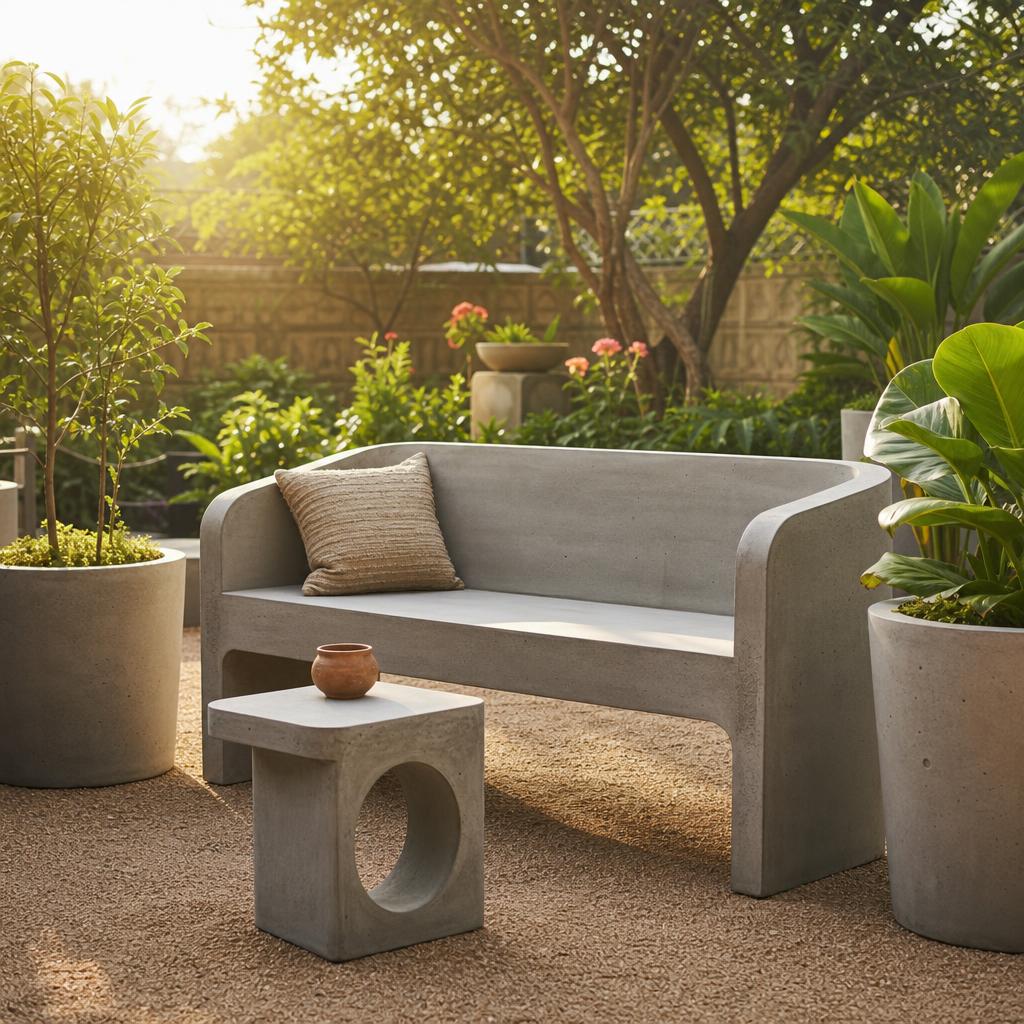
A cement bench is one of the most permanent and practical additions to any garden, entrance, courtyard, public space or institutional ground. Built with the right proportions, a well-designed cement bench becomes a feature in its own right — an invitation to sit, a place to pause, a visual anchor for the surrounding space. Balodiya Cemented Products has been making cement bench designs for homeowners, builders and institutions across North India for over 35 years, producing benches that last and look better with every passing season.
Cement bench designs that suit every outdoor setting
Our cement bench range covers single, double and triple-seat designs in plain and decoratively profiled leg styles, with backless, low-back and full-back options to suit different seating needs and garden styles. Standard bench lengths range from 1200mm to 2400mm. Seat height is designed for comfortable use: 430mm to 450mm from finished ground to seat surface — the ergonomically accepted range for seated human proportions. Custom lengths and heights are available for specific project requirements where standard dimensions do not fit the space.
In a garden, a cement bench at the right position transforms a planted area into a usable outdoor room. At the entrance to a home, a pair of cement benches on either side of the doorstep creates a welcoming gesture and a practical waiting area. In a public park or institution, cement benches provide seating that serves many users reliably without the maintenance burden of iron, wood or plastic alternatives. In every context, the key to a successful cement bench is the same: the right proportions, the right position and the right design for the scale and character of the surrounding space.
- Single, double and triple-seat designs
- Plain and decoratively profiled leg styles
- Backless, low-back and full-back options
- Custom sizes for specific garden layouts
- Park and public space institutional designs
- Planter-integrated bench combinations
What makes a cement bench design successful
A cement bench that works well is not simply a horizontal slab on two supports. The successful cement bench is the result of considered design decisions about proportion, seating geometry, leg profile, surface texture, back support and placement — all made in the context of the space the bench will inhabit and the people who will use it.
Seat proportion is the most fundamental decision. A seat too shallow (less than 380mm front-to-back) does not support the full thigh and is uncomfortable for extended sitting. A seat too deep (more than 480mm) makes it difficult for shorter people to sit comfortably with their feet on the ground. A seat width appropriate for the intended number of users — 600mm per person as a comfortable working allowance — determines whether a bench for two people is 1200mm or 1500mm wide depending on the design of the armrests and the bench ends.
Seat height is equally important. The standard seated human popliteal height (the distance from the floor to the back of the knee) ranges from 390mm to 450mm in the Indian adult population. A seat height of 430mm to 450mm suits most people comfortably. Our standard cement bench designs use a seat height of 440mm — within the comfortable range for most users while accounting for the 50mm to 75mm rise of most outdoor cushion pads when they are used.
Leg design determines the visual weight and character of the bench. Plain slab legs — a simple flat panel at each end of the seat — give the bench a clean, contemporary appearance with minimum material use. Profiled legs — with chamfered edges, recessed panels or moulded details — give the bench a more traditional or decorative character. Our profiled leg designs range from simple corner chamfering that reduces visual weight without significantly increasing production complexity to fully moulded legs with panel details that coordinate with the jali or pillar patterns used elsewhere on the property.
Back support is the decision that most affects the comfort of extended sitting. A backless bench (a flat seat slab with no back) is comfortable for short periods and suits garden settings where the bench is used for brief pauses rather than extended sitting. A low-back bench (a back support of 300 to 400mm height) provides lower back support for more comfortable extended sitting while maintaining a visual openness from behind. A full-back bench (a back support of 600mm or more) provides full spinal support for the most comfortable extended sitting and is preferred for institutional applications where benches are used for longer periods.
Surface texture on the seat face affects both comfort and aesthetics. A smooth cement seat surface is easy to clean but can feel cold in winter and hot in summer where the bench is in direct sunlight. A lightly textured surface improves grip (important for wet-weather use) and reflects its material quality more honestly. A relief-patterned seat surface adds decorative interest but can be uncomfortable for long sitting without a cushion. Our standard bench designs use a lightly textured seat surface that balances comfort, aesthetics and maintenance requirements.
Planter-bench combinations are one of the most practical and visually satisfying configurations in our range. The combination piece — a cement bench seat flanked by a precast planter at each end — serves three functions simultaneously: the seat provides comfortable outdoor seating, the planters provide visual anchoring and allow plant integration into the bench design, and the combined form creates a self-sufficient outdoor feature that works as a complete spatial element without requiring any additional furniture around it. These combination pieces are particularly popular for garden entrances, courtyard features and resort garden focal points.
Institutional cement bench design prioritises robustness, accessibility and ease of maintenance over decorative refinement. For schools, hospitals, religious institutions and public parks, our institutional bench designs have heavier proportions, no projecting edges that could cause injury, clear sight lines under the seat for cleaning, stable bases that resist rocking and an overall scale appropriate for use by a diverse public in a high-traffic setting.
Cement bench types from Balodiya
Garden bench — plain leg: Clean, contemporary bench design with slab legs. Available in single-seat (1200mm), double-seat (1500mm) and triple-seat (2000mm to 2400mm). Suitable for residential gardens, courtyards and minimally styled outdoor spaces.
Garden bench — profiled leg: Bench with decoratively moulded legs. Profile options coordinate with jali, pillar and railing designs from our standard range. Adds decorative character appropriate for traditional and heritage-influenced garden settings.
Backless garden bench: Minimalist seating for garden positions where the bench is used briefly and will be viewed from multiple sides. Low visual profile suits positions surrounded by planting where the bench should blend rather than dominate.
Planter-bench combination: Bench seat flanked by integrated planters. Available in the same leg profiles as our garden benches. The most versatile and self-contained garden furniture format in our range.
Institutional public bench: Robust, accessible design for parks, schools, hospitals and public gathering spaces. Heavier proportions, no sharp projections, clear underside for cleaning. Available in single, double and triple-seat lengths.
Six principles for placing and using cement benches
Position toward a pleasant view
The direction a bench faces determines how pleasant it is to use. A bench facing a wall or fence is less appealing than one facing a garden view, a water feature or an interesting planting arrangement. Think about what the bench user will see before deciding on position — it is the most important factor in whether a bench gets used regularly.
Provide shade for summer use
A cement bench in direct afternoon sun in North India will be too hot to sit on from April to October. Position garden benches where a tree canopy, a pergola, an overhead shade structure or a wall provides shade for at least part of the day. East-facing benches receive cooler morning sun; west-facing positions are most problematic for afternoon heat.
Prepare a stable, level base
The bench must be placed on a stable, level surface. An unstable or sloping base causes the bench to rock, which is uncomfortable and eventually stresses the bench structure. Prepare a small concrete pad or compacted aggregate base that extends 150mm beyond the bench feet on all sides before the bench arrives on site.
Add cushions for comfort
Outdoor foam cushions in weather-resistant covers transform a cement bench from occasional to regular use. The added comfort makes the bench genuinely pleasant for meals, conversation and extended relaxation. Store cushions indoors during the monsoon or in a waterproof storage box to extend their life significantly.
Coordinate with nearby garden elements
A cement bench that coordinates with nearby planters, pathway tiles or boundary jali — through related proportions, surface texture or decorative details — creates a more cohesive garden environment. Choose bench proportions and finish that reference other cemented elements in the garden rather than treating the bench as an isolated object.
Maintain annually
Inspect the bench base annually for settlement or cracking. Check paint for chips and touch up before moisture penetrates. Clear moss and leaf debris from flat surfaces. Wash annually with water and a soft brush. Annual inspection and basic care is all that cement bench maintenance requires for decades of good performance.
Standard and custom bench designs from Balodiya
To order cement benches, share the intended location, number of seats, back support preference, leg style preference, surface finish preference and delivery location. If the bench will be placed in a garden with other cemented elements, tell us about them — we can suggest a bench design that coordinates with the rest of your outdoor cemented design palette.
For large or custom orders — multiple benches for an institutional or commercial property, benches at non-standard dimensions, or planter-bench combinations in specific sizes — we discuss the full project scope before production begins and prepare a timeline that coordinates delivery with your installation schedule.
Contact us at +91 90414 58526 or balodiyacementedproducts.com to discuss your cement bench project. We deliver across Punjab, Rajasthan, Haryana and Himachal Pradesh.
Cement bench questions answered
What seat heights are available for cement benches?
Our standard seat height is 440mm from finished ground to seat top surface — comfortable for most adult users. Custom heights are available for specific requirements, including lower heights for children's spaces and accessible design applications.
Can I get a cement bench with armrests?
Yes. Armrests can be integrated into bench designs as part of the planter-bench combination form or as individual design elements in custom bench orders. Standard bench designs are armrest-free; contact us to discuss armrest options for specific applications.
How much does a cement bench weigh?
Weight depends on size and design. A standard 1500mm double bench weighs approximately 80 to 120kg. This weight makes the bench stable and permanent but requires appropriate handling and delivery equipment. We discuss handling requirements when confirming orders.
Can cement benches be painted any colour?
Yes. After proper curing, all our cement bench designs can be painted in any exterior-grade colour. Priming before the topcoat improves adhesion. We recommend a quality exterior paint for painted benches in exposed outdoor positions.
Do you supply cement benches for parks and public spaces?
Yes. Our institutional bench range is designed for parks, schools, hospitals, religious institutions and public gathering spaces. These designs prioritise robustness, safety and ease of maintenance for high-traffic public use.
Can benches be ordered in custom lengths?
Yes. Custom lengths are available for specific garden layouts or seating requirements. Standard lengths are 1200mm, 1500mm and 2000 to 2400mm. Other lengths are available on request.
Are planter-bench combinations available as a single precast piece?
Yes. Our planter-bench combinations are precast as a complete unit — seat and flanking planters in one piece — for stability and visual cohesion. Contact us for available designs and custom options.
How long does a cement bench last?
A properly made and maintained cement bench should last 30 to 50 years or more. The material does not rot, rust or deteriorate under weathering when properly produced and installed on an adequate base.
Need a bench that lasts as long as your garden? Talk to us.
Share your garden layout, seat count, back support preference and delivery location. Balodiya Cemented Products will help you choose a cement bench design that becomes a permanent and appreciated feature of your outdoor space.